



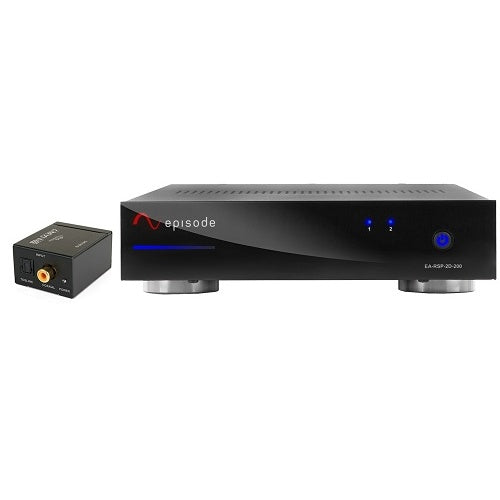
Episode KIT-EA-RSP-2D-DAC Amplifier Kit DSP Digital Converter
Episode KIT-EA-RSP-2D-DAC includes one 2-channel DSP amplifier and one optical/coaxial DAC for powering passive speakers from a TV or digital source. Supports 2-channel PCM only. Speakers, cables, and streaming source are sold separately.
Tax excluded. Shipping calculated at checkout
Free U.S. shipping is available on orders over $499.99.
Personalized pricing may be available for a single item, multiple products, larger quantities, or competitive quotes.
Before You Buy
Check compatibility, what’s included, key specifications, and installation requirements in the Product Details below. Need help confirming compatibility? Contact us before ordering.
Shipping Information
A tracking number is provided by email after the order has shipped. U.S. only: Orders usually process in 1 to 2 business days, with delivery typically taking 3 to 6 business days after shipment. Free shipping on orders over $499.99 For more information, please see our Shipping Policy here.
30 Day Returns & Warranty
We accept returns within 30 days of delivery for unused, uninstalled items in original packaging. Many products also include a manufacturer warranty. For more information, please see our Refund Policy here.
Episode KIT-EA-RSP-2D-DAC Amplifier Kit DSP Digital Converter
Product Details
Connect a Digital Audio Source to One Powerful Speaker Zone
The Episode KIT-EA-RSP-2D-DAC combines an EA-RSP-2D-200 two-channel DSP amplifier with a Binary B-220-DAC digital-to-analog converter. It is designed for a single speaker zone where a TV, media player, or other source provides optical or coaxial digital audio but the amplifier and speaker system require an analog signal.
The included DAC converts compatible 2-channel PCM audio into stereo RCA. The Episode amplifier then powers passive speakers while providing DSP equalization, crossover control, delay, limiting, Ethernet configuration, IP control, and OvrC remote-management support.
Best Uses for This Kit
- Connecting a television's optical output to passive in-wall, in-ceiling, bookshelf, or outdoor speakers
- Adding powerful stereo audio to a media room, patio, bar, office, conference room, or listening area
- Upgrading a source that has digital audio output but no usable analog RCA output
- Creating one DSP-managed stereo speaker zone with optional subwoofer integration
- Adding IP, IR, trigger, or compatible control-system operation to a passive-speaker system
Who Should Buy It
Choose this kit when you need to drive passive low-impedance speakers from a source with Toslink optical or coaxial digital output. It is especially useful when you want more power and system tuning than a basic stereo amplifier provides.
It is also a good choice when the amplifier will be located in a rack, cabinet, equipment room, or other indoor location and you want browser-based configuration, DSP presets, IP control, OvrC support, or integration with a compatible automation system.
Who Should Choose Another Product
- Choose a streaming amplifier if you need built-in Bluetooth, Wi-Fi, AirPlay, Spotify Connect, or another streaming platform.
- Choose an AV receiver if you need HDMI switching, HDMI ARC or eARC, Dolby Digital, DTS, surround decoding, or multiple home-theater channels.
- Choose a multi-zone amplifier or audio matrix if you need several independently controlled rooms or sources.
- Choose a dedicated 70V or 100V amplifier for distributed constant-voltage speaker systems.
- Choose a simpler integrated amplifier if you need a front-panel input selector and conventional volume knob.
- Do not use this kit to power active or powered speakers through its speaker-level outputs.
What Is Included
- One Episode EA-RSP-2D-200 Response Series two-channel DSP amplifier
- One Binary B-220-DAC digital-to-analog audio converter
- Amplifier IEC power cable
- Four amplifier feet
- Two amplifier rack-mount ears and mounting screws
Packaging note: The DAC requires a 5V DC, 2A external power supply. The official kit listing confirms the amplifier and DAC but does not separately itemize every accessory packed with the DAC. Confirm the supplied adapter with Bear Security Shop when that detail is critical to your project.
What Must Be Supplied Separately
- Compatible passive speakers
- Speaker wire
- Toslink optical or coaxial digital audio cable
- Stereo RCA cable between the DAC and amplifier
- Ethernet cable and local network connection when using browser configuration, IP control, or OvrC
- Audio source such as a TV, media player, streamer, or other compatible device
- Compatible controller, IR receiver, or trigger cable when required by the control design
- Powered subwoofer or separate subwoofer amplifier when adding a passive subwoofer
Amplifier Output and Speaker Compatibility
- 4-ohm stereo output: 2 × 200W at 1 kHz
- 8-ohm stereo output: 2 × 100W at 1 kHz
- 8-ohm bridged mono output: 1 × 400W at 1 kHz
- Amplifier topology: Class D
- Frequency response: 20 Hz to 20 kHz, within ±2 dB
- Speaker connections: Five-way binding posts
These are the manufacturer's published output ratings at 1 kHz. They should not be described as peak-power figures or relabeled as RMS unless the manufacturer explicitly uses that terminology.
The amplifier has one two-channel output stage. It can operate as one stereo zone or as one higher-powered bridged mono output. The number of speakers that can be connected depends on the total impedance presented to each channel, not only the wattage printed on the speakers.
Published power ratings are provided for 4-ohm and 8-ohm loads. Confirm the total speaker impedance, wiring method, speaker power handling, and DSP limiter settings before connecting multiple speakers to the same channel.
Digital Audio Compatibility
- Digital inputs: One Toslink optical input and one coaxial S/PDIF input
- Input use: Optical or coaxial may be connected, but the DAC does not switch between them
- Supported audio: 2-channel PCM digital audio
- Supported sample rates: 32, 44.1, 48, and 96 kHz
- Supported incoming bit depth: Up to 24-bit S/PDIF
- Analog output: Stereo left and right RCA
When connecting a TV, Apple TV, Blu-ray player, game console, or another surround-capable source, set its digital audio output to PCM, stereo, 2-channel, or downmix. The DAC does not decode Dolby Digital, DTS, or other multichannel bitstreams.
This kit does not include HDMI, HDMI ARC, or HDMI eARC. The source must provide compatible Toslink optical or coaxial digital audio.
DSP and Audio Adjustment
The amplifier's browser interface provides audio controls that are not normally available on a basic power amplifier, including:
- 10-band parametric equalization
- Tone controls
- High-pass and low-pass filtering
- Audio delay
- Output limiting
- Input gain adjustment and anti-clipping support
- Episode speaker presets and custom DSP presets
- Volume and mute control
The DSP limiter should be configured according to the connected speakers. A 200-watt amplifier channel does not mean every connected speaker should receive 200 watts continuously.
Network and Control Capabilities
- 10/100 Ethernet connection
- Local browser-based configuration
- IP control
- OvrC remote management, monitoring, and alerts
- IR input and output
- 4.5V to 12V trigger input
- 12V trigger output
- Available drivers and integration resources for compatible control systems
- Audio Sense, Voltage Trigger, and Power Button operating modes
The Ethernet port does not carry audio. It is used for configuration, control, monitoring, and integration. This amplifier is not a network audio streamer and is not powered through PoE.
The front panel provides power and status functions but does not operate like a traditional receiver with a front volume knob and source selector. Plan to control volume through the source, browser interface, IP commands, IR, or a compatible control system.
Inputs, Outputs, and Expansion
- One stereo RCA analog input
- One stereo RCA analog loop output for feeding another amplifier
- One mono RCA subwoofer output
- One stereo speaker output or one bridged mono speaker output
- Ethernet, IR input/output, and trigger input/output
The subwoofer output combines the left and right channels and uses a fixed 200 Hz low-pass filter with a 6 dB-per-octave slope. DSP low-pass settings applied to the main speaker outputs do not change the dedicated subwoofer output.
The subwoofer connection is line level. Use it with a powered subwoofer or a separate subwoofer amplifier. It cannot directly power a passive subwoofer.
70V, 100V, PoE, and Wireless Limitations
- This is a conventional low-impedance speaker amplifier, not a 70V or 100V amplifier.
- It does not provide PoE, PoE+, or PoE++ output.
- It is not powered through Ethernet.
- It does not include Bluetooth, Wi-Fi, or wireless audio transmission.
- It does not include a music-streaming service or streaming platform.
- OvrC and Ethernet connectivity do not make it a wireless or streaming amplifier.
Indoor and Outdoor-System Use
The amplifier and DAC are indoor electronics and should be installed in a dry, ventilated location. They are not weather resistant, waterproof, or intended for placement outdoors, near sprinklers, in damp areas, or where they may be exposed to rain or condensation.
The amplifier can power compatible outdoor speakers, provided the amplifier and DAC remain indoors and the speakers, wiring, connections, and installation method are suitable for outdoor use.
Power Requirements
- Amplifier AC input: 100-120V or 200-240V, 50/60 Hz
- Amplifier connection: IEC input with supplied power cable
- DAC power requirement: External 5V DC, 2A power supply
- Amplifier cooling: Fanless passive cooling
Follow the voltage and power markings on the supplied units and power adapters. Do not substitute an unapproved DAC power supply.
Dimensions and Weight
- EA-RSP-2D-200 amplifier: Approximately 16.5 inches wide × 8.3 inches deep × 1.8 inches high
- Amplifier height with feet: Approximately 2.2 inches
- Amplifier weight: 7.93 lb
- Rack space: 1U with the included rack ears
- B-220-DAC: Approximately 1.95 inches wide × 1.37 inches high × 1.56 inches deep
The current official DAC product listing states a weight of 0.33 lb, while an older official owner’s manual lists 0.18 lb. Confirm the exact revision when DAC weight is important to the design.
Warranty
The official component listings identify a two-year warranty for the EA-RSP-2D-200 amplifier and B-220-DAC. Current manufacturer limited-warranty terms, eligibility requirements, and exclusions apply.
Complete the System
- Browse compatible Episode products.
- Compare additional amplifiers.
- Shop in-wall and in-ceiling speakers.
- Shop outdoor speakers.
- Select the correct speaker wire.
- Add a compatible product from the subwoofer collection.
- Protect the system with suitable power management.
Need Help Confirming Compatibility?
Send Bear Security Shop your source model, available audio outputs, speaker models, speaker quantity, impedance, room or outdoor-area details, wiring plan, and preferred control method. We will help confirm whether this kit fits the system and identify any additional cables, controls, or amplification you may need.
Key Features
Complete Amplifier and Audio Converter Kit
Episode Response Series Amplifier (200W per Channel)
Includes Binary 220 Series Digital-to-Analog Audio Converter
Provides Simple Digital Input Integration
Flexible, Cost-Effective Audio Conversion Solution
High-Quality Digital Signal Processing (DSP) Amplifier
Ideal for Multiroom and Commercial Audio Applications
IP and OvrC Compatible for Remote Management
Bridgeable Output for Versatile Installations
Easy Setup and Integration into Any Audio Environment
FAQ
Is the Episode KIT-EA-RSP-2D-DAC sold individually or as a pair?
It is sold as one complete kit. The kit contains one EA-RSP-2D-200 amplifier and one B-220-DAC converter. It is not a pair of amplifiers, and speakers are not included.
What is required for this kit to work?
You need a compatible digital audio source, a Toslink optical or coaxial digital cable, a stereo RCA cable, passive speakers, speaker wire, AC power, and the DAC's required 5V DC, 2A power supply. An Ethernet connection is needed for browser configuration, IP control, or OvrC operation.
Is the amplifier powered or passive?
The EA-RSP-2D-200 is a powered Class D amplifier that connects to AC mains power. It is designed to drive passive low-impedance speakers. The B-220-DAC is also an active electronic device and requires 5V DC power.
What does the 200W x 2 rating mean?
The manufacturer rates the amplifier at 2 × 200W into 4 ohms at 1 kHz. It is rated at 2 × 100W into 8 ohms or 1 × 400W bridged into 8 ohms. These should be presented as manufacturer output ratings, not described as peak watts or automatically relabeled as RMS.
Can this kit power more than two speakers?
Possibly, but the total impedance connected to each amplifier channel must remain compatible with the amplifier. The published power ratings are for 4-ohm and 8-ohm loads. Confirm the speaker impedance, quantity, wiring arrangement, and required volume before connecting multiple speakers to one channel.
Can I connect a TV through its optical output?
Yes, provided the TV can output 2-channel PCM through Toslink optical. Set the TV's digital audio format to PCM or stereo. The DAC does not decode Dolby Digital, DTS, or another multichannel surround format.
Can I connect optical and coaxial sources at the same time?
The DAC provides both optical and coaxial inputs, but it does not provide input switching. Use one digital connection for the installation rather than treating the DAC as a two-source selector.
Does it support HDMI ARC or eARC?
No. The B-220-DAC accepts Toslink optical or coaxial S/PDIF digital audio. It does not have HDMI, ARC, or eARC connections.
Does this kit have Bluetooth, Wi-Fi, or built-in streaming?
No. It does not include Bluetooth audio, Wi-Fi audio, AirPlay, Spotify Connect, or another built-in streaming platform. A separate source or streamer is required.
What is the Ethernet connection used for?
Ethernet is used for local browser configuration, IP control, OvrC monitoring, firmware-related functions, and compatible control-system integration. Ethernet does not carry the program audio, and the amplifier is not powered through PoE.
Does a control system have to be installed?
No control system is required for basic amplification, but you must plan how the amplifier will be configured and how volume will be controlled. Options may include the browser interface, source-level control, IP commands, IR, audio sensing, voltage trigger, or a compatible control system.
Can the amplifier control volume from its front panel?
It does not have a conventional front-panel volume knob. Volume and mute are managed through the configured source, browser interface, IP or IR commands, or a compatible control system.
Is this a multi-zone amplifier?
No. The EA-RSP-2D-200 provides one two-channel output stage. It can operate as one stereo zone or one bridged mono output. Choose a larger multi-zone amplifier or audio matrix when several rooms need independent sources or volume control.
Does it support 70V or 100V speakers?
No direct 70V or 100V output is specified. This is a low-impedance amplifier intended for conventional passive speaker loads. Use a purpose-built 70V or 100V amplifier for a constant-voltage distributed speaker system.
Can I add a subwoofer?
Yes. The amplifier has a mono line-level RCA subwoofer output that combines the left and right channels. It uses a fixed 200 Hz low-pass filter with a 6 dB-per-octave slope. Use a powered subwoofer or a separate subwoofer amplifier because this output cannot directly power a passive subwoofer.
Can this kit be used with outdoor speakers?
It can power compatible outdoor-rated passive speakers, but the amplifier and DAC must remain indoors in a dry, ventilated location. The electronics are not waterproof or weather rated and should not be exposed to rain, sprinklers, condensation, or extreme outdoor conditions.
Can the amplifier or DAC be installed outdoors or below freezing?
No outdoor installation is specified. The amplifier's published operating range is 14°F to 122°F, but the manufacturer identifies that range for indoor operation. The DAC manual also warns against water, moisture, dripping, and splashing.
What are the amplifier dimensions and weight?
The EA-RSP-2D-200 measures approximately 16.5 inches wide × 8.3 inches deep × 1.8 inches high and weighs 7.93 lb. With its feet installed, the height is approximately 2.2 inches. It fits a 1U rack space using its rack ears.
What are the DAC dimensions and weight?
The current official listing gives approximate dimensions of 1.95 inches wide × 1.37 inches high × 1.56 inches deep. The current listing states 0.33 lb, while an older official manual states 0.18 lb, so confirm the exact product revision when weight is important.
What should I confirm before ordering?
Confirm that the source can output 2-channel PCM through optical or coaxial audio, that the speakers are passive and present a compatible impedance, that the output power is suitable for the speakers, and that you have the required digital, RCA, Ethernet, and speaker cables. Also confirm the preferred volume-control method, rack or shelf space, subwoofer requirements, and the DAC power-adapter packaging.
Connect a Digital Audio Source to One Powerful Speaker Zone
The Episode KIT-EA-RSP-2D-DAC combines an EA-RSP-2D-200 two-channel DSP amplifier with a Binary B-220-DAC digital-to-analog converter. It is designed for a single speaker zone where a TV, media player, or other source provides optical or coaxial digital audio but the amplifier and speaker system require an analog signal.
The included DAC converts compatible 2-channel PCM audio into stereo RCA. The Episode amplifier then powers passive speakers while providing DSP equalization, crossover control, delay, limiting, Ethernet configuration, IP control, and OvrC remote-management support.
Best Uses for This Kit
- Connecting a television's optical output to passive in-wall, in-ceiling, bookshelf, or outdoor speakers
- Adding powerful stereo audio to a media room, patio, bar, office, conference room, or listening area
- Upgrading a source that has digital audio output but no usable analog RCA output
- Creating one DSP-managed stereo speaker zone with optional subwoofer integration
- Adding IP, IR, trigger, or compatible control-system operation to a passive-speaker system
Who Should Buy It
Choose this kit when you need to drive passive low-impedance speakers from a source with Toslink optical or coaxial digital output. It is especially useful when you want more power and system tuning than a basic stereo amplifier provides.
It is also a good choice when the amplifier will be located in a rack, cabinet, equipment room, or other indoor location and you want browser-based configuration, DSP presets, IP control, OvrC support, or integration with a compatible automation system.
Who Should Choose Another Product
- Choose a streaming amplifier if you need built-in Bluetooth, Wi-Fi, AirPlay, Spotify Connect, or another streaming platform.
- Choose an AV receiver if you need HDMI switching, HDMI ARC or eARC, Dolby Digital, DTS, surround decoding, or multiple home-theater channels.
- Choose a multi-zone amplifier or audio matrix if you need several independently controlled rooms or sources.
- Choose a dedicated 70V or 100V amplifier for distributed constant-voltage speaker systems.
- Choose a simpler integrated amplifier if you need a front-panel input selector and conventional volume knob.
- Do not use this kit to power active or powered speakers through its speaker-level outputs.
What Is Included
- One Episode EA-RSP-2D-200 Response Series two-channel DSP amplifier
- One Binary B-220-DAC digital-to-analog audio converter
- Amplifier IEC power cable
- Four amplifier feet
- Two amplifier rack-mount ears and mounting screws
Packaging note: The DAC requires a 5V DC, 2A external power supply. The official kit listing confirms the amplifier and DAC but does not separately itemize every accessory packed with the DAC. Confirm the supplied adapter with Bear Security Shop when that detail is critical to your project.
What Must Be Supplied Separately
- Compatible passive speakers
- Speaker wire
- Toslink optical or coaxial digital audio cable
- Stereo RCA cable between the DAC and amplifier
- Ethernet cable and local network connection when using browser configuration, IP control, or OvrC
- Audio source such as a TV, media player, streamer, or other compatible device
- Compatible controller, IR receiver, or trigger cable when required by the control design
- Powered subwoofer or separate subwoofer amplifier when adding a passive subwoofer
Amplifier Output and Speaker Compatibility
- 4-ohm stereo output: 2 × 200W at 1 kHz
- 8-ohm stereo output: 2 × 100W at 1 kHz
- 8-ohm bridged mono output: 1 × 400W at 1 kHz
- Amplifier topology: Class D
- Frequency response: 20 Hz to 20 kHz, within ±2 dB
- Speaker connections: Five-way binding posts
These are the manufacturer's published output ratings at 1 kHz. They should not be described as peak-power figures or relabeled as RMS unless the manufacturer explicitly uses that terminology.
The amplifier has one two-channel output stage. It can operate as one stereo zone or as one higher-powered bridged mono output. The number of speakers that can be connected depends on the total impedance presented to each channel, not only the wattage printed on the speakers.
Published power ratings are provided for 4-ohm and 8-ohm loads. Confirm the total speaker impedance, wiring method, speaker power handling, and DSP limiter settings before connecting multiple speakers to the same channel.
Digital Audio Compatibility
- Digital inputs: One Toslink optical input and one coaxial S/PDIF input
- Input use: Optical or coaxial may be connected, but the DAC does not switch between them
- Supported audio: 2-channel PCM digital audio
- Supported sample rates: 32, 44.1, 48, and 96 kHz
- Supported incoming bit depth: Up to 24-bit S/PDIF
- Analog output: Stereo left and right RCA
When connecting a TV, Apple TV, Blu-ray player, game console, or another surround-capable source, set its digital audio output to PCM, stereo, 2-channel, or downmix. The DAC does not decode Dolby Digital, DTS, or other multichannel bitstreams.
This kit does not include HDMI, HDMI ARC, or HDMI eARC. The source must provide compatible Toslink optical or coaxial digital audio.
DSP and Audio Adjustment
The amplifier's browser interface provides audio controls that are not normally available on a basic power amplifier, including:
- 10-band parametric equalization
- Tone controls
- High-pass and low-pass filtering
- Audio delay
- Output limiting
- Input gain adjustment and anti-clipping support
- Episode speaker presets and custom DSP presets
- Volume and mute control
The DSP limiter should be configured according to the connected speakers. A 200-watt amplifier channel does not mean every connected speaker should receive 200 watts continuously.
Network and Control Capabilities
- 10/100 Ethernet connection
- Local browser-based configuration
- IP control
- OvrC remote management, monitoring, and alerts
- IR input and output
- 4.5V to 12V trigger input
- 12V trigger output
- Available drivers and integration resources for compatible control systems
- Audio Sense, Voltage Trigger, and Power Button operating modes
The Ethernet port does not carry audio. It is used for configuration, control, monitoring, and integration. This amplifier is not a network audio streamer and is not powered through PoE.
The front panel provides power and status functions but does not operate like a traditional receiver with a front volume knob and source selector. Plan to control volume through the source, browser interface, IP commands, IR, or a compatible control system.
Inputs, Outputs, and Expansion
- One stereo RCA analog input
- One stereo RCA analog loop output for feeding another amplifier
- One mono RCA subwoofer output
- One stereo speaker output or one bridged mono speaker output
- Ethernet, IR input/output, and trigger input/output
The subwoofer output combines the left and right channels and uses a fixed 200 Hz low-pass filter with a 6 dB-per-octave slope. DSP low-pass settings applied to the main speaker outputs do not change the dedicated subwoofer output.
The subwoofer connection is line level. Use it with a powered subwoofer or a separate subwoofer amplifier. It cannot directly power a passive subwoofer.
70V, 100V, PoE, and Wireless Limitations
- This is a conventional low-impedance speaker amplifier, not a 70V or 100V amplifier.
- It does not provide PoE, PoE+, or PoE++ output.
- It is not powered through Ethernet.
- It does not include Bluetooth, Wi-Fi, or wireless audio transmission.
- It does not include a music-streaming service or streaming platform.
- OvrC and Ethernet connectivity do not make it a wireless or streaming amplifier.
Indoor and Outdoor-System Use
The amplifier and DAC are indoor electronics and should be installed in a dry, ventilated location. They are not weather resistant, waterproof, or intended for placement outdoors, near sprinklers, in damp areas, or where they may be exposed to rain or condensation.
The amplifier can power compatible outdoor speakers, provided the amplifier and DAC remain indoors and the speakers, wiring, connections, and installation method are suitable for outdoor use.
Power Requirements
- Amplifier AC input: 100-120V or 200-240V, 50/60 Hz
- Amplifier connection: IEC input with supplied power cable
- DAC power requirement: External 5V DC, 2A power supply
- Amplifier cooling: Fanless passive cooling
Follow the voltage and power markings on the supplied units and power adapters. Do not substitute an unapproved DAC power supply.
Dimensions and Weight
- EA-RSP-2D-200 amplifier: Approximately 16.5 inches wide × 8.3 inches deep × 1.8 inches high
- Amplifier height with feet: Approximately 2.2 inches
- Amplifier weight: 7.93 lb
- Rack space: 1U with the included rack ears
- B-220-DAC: Approximately 1.95 inches wide × 1.37 inches high × 1.56 inches deep
The current official DAC product listing states a weight of 0.33 lb, while an older official owner’s manual lists 0.18 lb. Confirm the exact revision when DAC weight is important to the design.
Warranty
The official component listings identify a two-year warranty for the EA-RSP-2D-200 amplifier and B-220-DAC. Current manufacturer limited-warranty terms, eligibility requirements, and exclusions apply.
Complete the System
- Browse compatible Episode products.
- Compare additional amplifiers.
- Shop in-wall and in-ceiling speakers.
- Shop outdoor speakers.
- Select the correct speaker wire.
- Add a compatible product from the subwoofer collection.
- Protect the system with suitable power management.
Need Help Confirming Compatibility?
Send Bear Security Shop your source model, available audio outputs, speaker models, speaker quantity, impedance, room or outdoor-area details, wiring plan, and preferred control method. We will help confirm whether this kit fits the system and identify any additional cables, controls, or amplification you may need.
Complete Amplifier and Audio Converter Kit
Episode Response Series Amplifier (200W per Channel)
Includes Binary 220 Series Digital-to-Analog Audio Converter
Provides Simple Digital Input Integration
Flexible, Cost-Effective Audio Conversion Solution
High-Quality Digital Signal Processing (DSP) Amplifier
Ideal for Multiroom and Commercial Audio Applications
IP and OvrC Compatible for Remote Management
Bridgeable Output for Versatile Installations
Easy Setup and Integration into Any Audio Environment
Is the Episode KIT-EA-RSP-2D-DAC sold individually or as a pair?
It is sold as one complete kit. The kit contains one EA-RSP-2D-200 amplifier and one B-220-DAC converter. It is not a pair of amplifiers, and speakers are not included.
What is required for this kit to work?
You need a compatible digital audio source, a Toslink optical or coaxial digital cable, a stereo RCA cable, passive speakers, speaker wire, AC power, and the DAC's required 5V DC, 2A power supply. An Ethernet connection is needed for browser configuration, IP control, or OvrC operation.
Is the amplifier powered or passive?
The EA-RSP-2D-200 is a powered Class D amplifier that connects to AC mains power. It is designed to drive passive low-impedance speakers. The B-220-DAC is also an active electronic device and requires 5V DC power.
What does the 200W x 2 rating mean?
The manufacturer rates the amplifier at 2 × 200W into 4 ohms at 1 kHz. It is rated at 2 × 100W into 8 ohms or 1 × 400W bridged into 8 ohms. These should be presented as manufacturer output ratings, not described as peak watts or automatically relabeled as RMS.
Can this kit power more than two speakers?
Possibly, but the total impedance connected to each amplifier channel must remain compatible with the amplifier. The published power ratings are for 4-ohm and 8-ohm loads. Confirm the speaker impedance, quantity, wiring arrangement, and required volume before connecting multiple speakers to one channel.
Can I connect a TV through its optical output?
Yes, provided the TV can output 2-channel PCM through Toslink optical. Set the TV's digital audio format to PCM or stereo. The DAC does not decode Dolby Digital, DTS, or another multichannel surround format.
Can I connect optical and coaxial sources at the same time?
The DAC provides both optical and coaxial inputs, but it does not provide input switching. Use one digital connection for the installation rather than treating the DAC as a two-source selector.
Does it support HDMI ARC or eARC?
No. The B-220-DAC accepts Toslink optical or coaxial S/PDIF digital audio. It does not have HDMI, ARC, or eARC connections.
Does this kit have Bluetooth, Wi-Fi, or built-in streaming?
No. It does not include Bluetooth audio, Wi-Fi audio, AirPlay, Spotify Connect, or another built-in streaming platform. A separate source or streamer is required.
What is the Ethernet connection used for?
Ethernet is used for local browser configuration, IP control, OvrC monitoring, firmware-related functions, and compatible control-system integration. Ethernet does not carry the program audio, and the amplifier is not powered through PoE.
Does a control system have to be installed?
No control system is required for basic amplification, but you must plan how the amplifier will be configured and how volume will be controlled. Options may include the browser interface, source-level control, IP commands, IR, audio sensing, voltage trigger, or a compatible control system.
Can the amplifier control volume from its front panel?
It does not have a conventional front-panel volume knob. Volume and mute are managed through the configured source, browser interface, IP or IR commands, or a compatible control system.
Is this a multi-zone amplifier?
No. The EA-RSP-2D-200 provides one two-channel output stage. It can operate as one stereo zone or one bridged mono output. Choose a larger multi-zone amplifier or audio matrix when several rooms need independent sources or volume control.
Does it support 70V or 100V speakers?
No direct 70V or 100V output is specified. This is a low-impedance amplifier intended for conventional passive speaker loads. Use a purpose-built 70V or 100V amplifier for a constant-voltage distributed speaker system.
Can I add a subwoofer?
Yes. The amplifier has a mono line-level RCA subwoofer output that combines the left and right channels. It uses a fixed 200 Hz low-pass filter with a 6 dB-per-octave slope. Use a powered subwoofer or a separate subwoofer amplifier because this output cannot directly power a passive subwoofer.
Can this kit be used with outdoor speakers?
It can power compatible outdoor-rated passive speakers, but the amplifier and DAC must remain indoors in a dry, ventilated location. The electronics are not waterproof or weather rated and should not be exposed to rain, sprinklers, condensation, or extreme outdoor conditions.
Can the amplifier or DAC be installed outdoors or below freezing?
No outdoor installation is specified. The amplifier's published operating range is 14°F to 122°F, but the manufacturer identifies that range for indoor operation. The DAC manual also warns against water, moisture, dripping, and splashing.
What are the amplifier dimensions and weight?
The EA-RSP-2D-200 measures approximately 16.5 inches wide × 8.3 inches deep × 1.8 inches high and weighs 7.93 lb. With its feet installed, the height is approximately 2.2 inches. It fits a 1U rack space using its rack ears.
What are the DAC dimensions and weight?
The current official listing gives approximate dimensions of 1.95 inches wide × 1.37 inches high × 1.56 inches deep. The current listing states 0.33 lb, while an older official manual states 0.18 lb, so confirm the exact product revision when weight is important.
What should I confirm before ordering?
Confirm that the source can output 2-channel PCM through optical or coaxial audio, that the speakers are passive and present a compatible impedance, that the output power is suitable for the speakers, and that you have the required digital, RCA, Ethernet, and speaker cables. Also confirm the preferred volume-control method, rack or shelf space, subwoofer requirements, and the DAC power-adapter packaging.
RELATED PRODUCTS
Discover Other Products You Might Like and Simplify Your Search
Why Customers Keep Coming Back
Real feedback from customers nationwide on our service, shipping, and support.

M. from New Jersey
Outstanding customer service speakers arrived cross country Cali to New Jersey in spectacular condition.
Great communication great packaging would buy again.

M. from Louisiana
Product arrived quickly and in good condition. The price was very competitive. I’m very satisfied. I highly recommend the seller.
G. from Texas
Place a large order and was able to accommodate me quickly and parts were delivered as promised
R. from California
Easy ordering and super fast standard shipping. Great experience and highly recommended.
B. from Texas
Arrived promptly & in excellent condition with all required parts. Sounds great and impedance matches other speakers.
E. from Arizona
Great products, easy ordering, prompt shipping
S. from Florida
Excellent customer service! Picks up the phone. Fast delivery across the country. Worthy online retailer!
G. from Texas
Bear Security Shop has a great customer service, and is fast and easy to do business with. I've ordered product from them twice with great service both times. Would definitely recommend them.
J. from Los Angeles
Excellent customer service. Lightning fast shipping. Very grateful for the team at Bear Security. Thank you!
T. from Oklahoma
Trustworthy, honest, and plus integrity, with outstanding professionalism! I highly recommend them buy with confidence!

C. from Colorado
Experience with Bear Security Shop was fast and easy and the speakers arrived less than we week after ordering. And the price was half what my installer wanted to charge me for these speakers. Highly recommended.
V. from California
Excellent communication. Prompt responses and very knowledgeable and helpful. Items arrived faster than expected and in brand new condition as described. Will continue to do business with them.
C. from South Dakota
Awesome camras well worth the money good seller would buy again 👍
Get Expert Picks and Real Setup Advice
Subscribe for practical tips, product recommendations, and occasional subscriber only deals. No spam.