



Episode ES-SUB-EVO10-450-BLK 10 Inch 480W Sealed Subwoofer
Sealed 10-inch powered subwoofer for living rooms, media rooms, music systems, and home theaters. Features a woven-fiberglass driver, 200W RMS/480W peak DRiVE Class-D amplification, a 23Hz–200Hz published range, LFE and stereo RCA connections, speaker-level inputs and outputs, adjustable crossover and phase, automatic signal sensing, and optional wireless-kit support.
Tax excluded. Shipping calculated at checkout
Free U.S. shipping is available on orders over $499.99.
Personalized pricing may be available for a single item, multiple products, larger quantities, or competitive quotes.
Shipping Information
A tracking number is provided by email after the order has shipped. U.S. only: Orders usually process in 1 to 2 business days, with delivery typically taking 3 to 6 business days after shipment. Free shipping on orders over $499.99 For more information, please see our Shipping Policy here.
30 Day Returns & Warranty
We accept returns within 30 days of delivery for unused, uninstalled items in original packaging. Many products also include a manufacturer warranty. For more information, please see our Refund Policy here.
Official Product Resources
ES-SUB-EVO10-450-BLK Product Manual & Specs
View the official ES-SUB-EVO10-450-BLK manual for product specifications, setup details, wiring guidance, and installation reference before ordering.
Open ES-SUB-EVO10-450-BLK Manual PDFOpens the official PDF manual in a new tab, where you can view, save, or print the file from your browser.
Episode ES-SUB-EVO10-450-BLK 10 Inch 480W Sealed Subwoofer
Product Details
Controlled Bass for Movies, Music, and Gaming
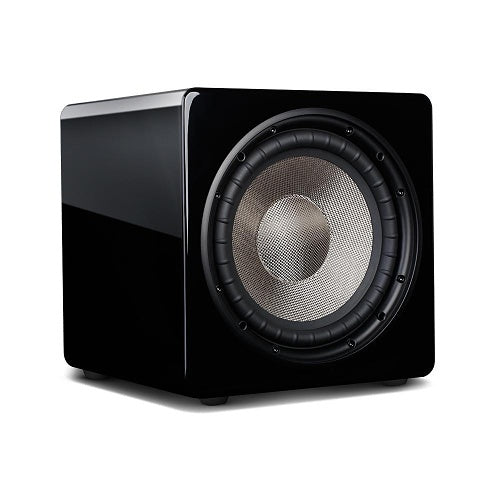
The Episode ES-SUB-EVO10-450-BLK is a 10-inch powered subwoofer designed for living rooms, media rooms, gaming systems, music setups, and home theaters that need stronger output than a compact 8-inch model without moving to a much larger cabinet.
Its sealed enclosure contains a woven-fiberglass woofer powered by Episode’s efficient DRiVE Class-D amplifier. LFE, stereo RCA, and speaker-level connections provide compatibility with AV receivers, processors, stereo amplifiers, and other audio systems.
The built-in amplifier delivers 200W RMS and 480W peak. The 480W figure is a peak rating, not continuous amplifier output.
Best Use Cases
- Living rooms: Add movie and music bass without using an oversized cabinet.
- Media rooms: Provide more impact and headroom than the smaller EVO8.
- Home theaters: Reproduce the dedicated LFE channel from a compatible AV receiver or processor.
- Music systems: Extend bookshelf, in-wall, in-ceiling, and floorstanding speakers into lower frequencies.
- Gaming setups: Reinforce effects, soundtracks, vehicles, and environmental audio.
- Systems without a subwoofer pre-out: Connect through the high-level speaker-wire inputs and outputs.
- Wireless retrofit projects: Add the separately sold Episode wireless subwoofer kit when running a long signal cable is impractical.
Who Should Buy This?
This is a strong choice when the EVO8 is too small for the room or preferred listening level, but the size and output of the EVO12 are unnecessary.
It is particularly suitable for buyers who value a sealed enclosure, straightforward rear-panel controls, both line-level and speaker-level connections, and a relatively compact piano-gloss cabinet.
Who Should Not Buy This?
This may not provide enough output for a very large dedicated theater, a large open-concept room, or listeners seeking extremely high playback levels. The larger EVO12 or a higher-output MEGA model may be more appropriate in those situations.
This is not a passive subwoofer. It contains its own amplifier and requires AC power.
It is not wireless out of the box. Wireless audio requires the separately sold Episode wireless subwoofer kit. The rear USB port only supplies power to the optional wireless receiver.
It does not include Bluetooth, Wi-Fi, app control, Ethernet, automatic room correction, or a 12V trigger.
The subwoofer is intended for dry indoor use and should not be exposed to rain, dripping water, outdoor humidity, or blocked ventilation.
Sold Individually
The ES-SUB-EVO10-450-BLK is sold as one complete powered subwoofer.
One subwoofer may provide sufficient bass for many rooms. Two properly positioned subwoofers can improve consistency across multiple listening seats when the receiver or processor supports the required connections and calibration.
10-Inch Woven-Fiberglass Driver
The subwoofer uses one 10-inch woven-fiberglass cone driver with a Nomex spider, ribbed surround, and high-temperature 1.5-inch voice coil.
The rigid, lightweight driver is designed for controlled movement and low-frequency reproduction from the sealed enclosure.
This is a single-driver design. It should not be described as a dual-driver subwoofer or as using a passive radiator.
Sealed Enclosure
The EVO10 uses a sealed cabinet instead of a ported design.
A sealed enclosure supports compact dimensions and controlled transient response, making it a practical choice for music, television, gaming, and home-theater systems.
Actual bass performance still depends on room dimensions, placement, seating location, crossover settings, phase, receiver calibration, and preferred listening level.
200W RMS and 480W Peak Amplification
The built-in DRiVE Class-D amplifier is rated at 200W RMS at 0.2% THD and 480W peak.
The 200W RMS figure is the continuous amplifier rating and should be used as the primary power specification.
The 480W specification represents short-duration peak capability. It should not be described as 480W RMS or continuous output.
No separate subwoofer amplifier is required.
Efficient DRiVE Class-D Technology
Episode’s DRiVE digital amplifier is designed to provide efficient low-frequency power while generating less heat than many conventional analog amplifier designs.
Episode publishes standby power consumption below 0.5W.
The cabinet still requires adequate airflow and access to the rear controls, connections, voltage selector, fuse holder, and power cord.
LFEQ Internal Equalization
Episode’s LFEQ technology uses internal dual equalization to shape the output of the driver and sealed enclosure for extended low-frequency performance.
LFEQ is built-in product tuning. It is not automatic room correction, app-based DSP, or microphone calibration.
Correct placement, crossover, phase, and receiver setup remain necessary.
Published Frequency Performance
Episode’s current online specification table lists a broad published frequency range of 23Hz to 200Hz.
The official installation manual separately identifies approximately 28Hz as the lower -3 dB point.
These values use different reporting conventions. Customer-facing copy should distinguish the broad published range from the documented -3 dB specification instead of treating them as identical measurements.
50Hz–200Hz Adjustable Crossover
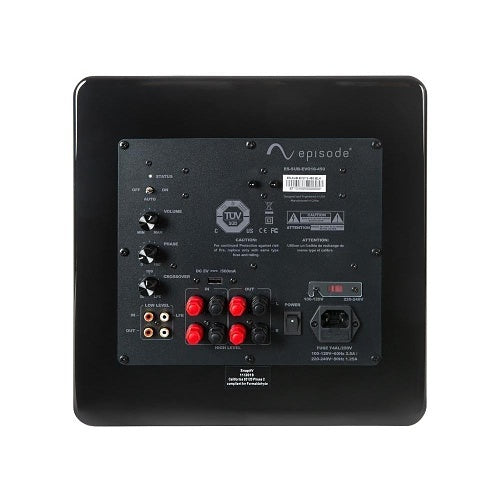
The rear crossover control adjusts the highest frequencies reproduced by the subwoofer from approximately 50Hz to 200Hz and includes an LFE position.
The correct setting depends on the low-frequency capability of the main speakers and whether bass management is handled by an AV receiver, processor, or the subwoofer.
When using a receiver’s dedicated Sub Out or LFE output, set the subwoofer control to LFE and manage the crossover through the receiver.
Continuously Adjustable Phase
The rear phase control is continuously variable from 0 to 180 degrees.
Phase adjustment helps align the subwoofer with the main speakers at the listening position.
Begin at 0 degrees and adjust while listening to familiar bass content from the primary seating area. Select the position that produces the strongest and most even integration with the main speakers.
Rear Volume Control
The volume control adjusts subwoofer output relative to the main speakers.
Episode recommends starting near the 12 o’clock or 50% position during setup.
After receiver calibration or manual adjustment, set the level so bass supports movies and music without overpowering dialogue, vocals, or instruments.
RCA and LFE Connections
The rear panel provides left and right low-level RCA inputs and outputs.
For a receiver or processor’s dedicated Sub Out or LFE connection, use the left RCA input, which Episode designates for LFE operation.
The RCA outputs can pass the corresponding low-level signal to another compatible component or subwoofer.
Use a shielded subwoofer or RCA cable with secure connectors.
Speaker-Level Inputs and Outputs
Gold-plated five-way binding posts provide left and right high-level inputs and outputs.
This allows the EVO10 to receive signal from an amplifier or receiver that provides speaker outputs but no dedicated subwoofer preamp output.
The high-level outputs pass the main speaker signal onward. They are not extra speaker channels powered by the EVO10’s internal amplifier.
Use One Input Method
Do not connect the RCA inputs and speaker-level inputs at the same time.
Use either the low-level RCA/LFE connection or the high-level speaker-wire connection.
Connecting both methods simultaneously may cause noise or improper operation.
Automatic Signal Sensing
The rear power-mode control provides Auto, Off, and On settings.
- Auto: Turns on when an audio signal is detected and enters standby after approximately 15 minutes without a signal.
- On: Keeps the subwoofer ready for operation.
- Off: Disables normal operation while AC remains connected.
The status LED is blue during operation and red in standby or when the mode control is set to Off while AC power remains available.
Optional Wireless Subwoofer Kit
The EVO10 is compatible with the separately sold Episode wireless subwoofer kit.
A rear 5V USB port provides up to 500mA to power the optional wireless receiver, and built-in holding bolts allow the receiver to be secured to the rear panel.
The subwoofer itself does not contain a wireless transmitter or receiver.
Wireless operation replaces the long source-signal cable. The powered subwoofer still requires an AC outlet.
AV Receiver Compatibility
Most AV receivers connect through the receiver’s Sub Out or LFE output and the EVO10’s left RCA/LFE input.
Set the crossover control to LFE and run the receiver’s speaker-calibration system when available.
The calculated subwoofer distance shown by the receiver may differ from the physical distance because filtering and phase behavior affect acoustic timing.
Stereo Amplifier Compatibility
A stereo amplifier with variable preamp outputs can connect through the RCA inputs.
An amplifier without a preamp or subwoofer output may connect through the high-level speaker inputs and outputs.
Do not connect the high-level terminals to a 70V or 100V constant-voltage speaker output.
Soundbar Compatibility
The EVO10 can work with a soundbar only when the soundbar or its control unit provides a compatible wired subwoofer, RCA, LFE, or speaker-level output.
It cannot pair directly with soundbars designed only for a proprietary wireless subwoofer.
Confirm the exact soundbar model and available outputs before ordering.
Placement Guidance
Subwoofer placement can significantly change output and bass consistency.
Placement near a wall or corner can increase perceived output, but it may also make certain frequencies excessive while weakening others.
Test several suitable floor positions and evaluate the result from the important listening seats before finalizing cable routing or furniture placement.
Switchable AC Voltage
The ES-SUB-EVO10-450 supports switchable 100–120V or 220–240V AC operation.
Confirm that the rear voltage selector matches the local electrical supply before connecting the power cord.
- 100–120V AC, 60Hz: Approximately 2.5A.
- 220–240V AC, 50Hz: Approximately 1.25A.
- Replaceable fuse: T4AL/250V.
Using the wrong voltage setting or fuse type may damage the subwoofer and create a safety hazard.
Technical Specifications
- Product type: Powered sealed subwoofer.
- Series: Episode Evolution.
- Model: ES-SUB-EVO10-450-BLK.
- Sold as: One powered subwoofer.
- Finish: Piano-gloss black.
- Driver: One 10-inch woven-fiberglass cone.
- Voice coil: High-temperature 1.5-inch voice coil.
- Suspension: Nomex spider and ribbed surround.
- Enclosure: Sealed.
- Amplifier: DRiVE Class-D.
- Continuous output: 200W RMS at 0.2% THD.
- Peak output: 480W.
- Published overall frequency range: 23Hz to 200Hz.
- Manual-specified lower point: Approximately 28Hz at -3 dB.
- Adjustable crossover: 50Hz to 200Hz, plus LFE position.
- Phase adjustment: Continuously variable from 0 to 180 degrees.
- Signal-to-noise ratio: 90 dB A-weighted.
- Low-level connections: Stereo RCA inputs and outputs; left RCA supports LFE.
- High-level connections: Gold-plated five-way binding-post inputs and outputs.
- Wireless support: Compatible with optional Episode wireless kit.
- Wireless-receiver power: 5V USB, up to 500mA.
- Power modes: Auto, Off, and On.
- Automatic standby: Approximately 15 minutes without signal.
- AC input: Switchable 100–120V or 220–240V.
- Replaceable fuse: T4AL/250V.
- Use location: Dry indoor environments.
Dimensions and Weight
- Width: Approximately 12.5 inches.
- Height: Approximately 13.1 inches.
- Depth: Approximately 13.7 inches.
- Weight: Approximately 25.4 lb.
Warranty
The official installation manual documents a two-year limited warranty on the amplifier and a ten-year limited warranty on the woofer and cabinet, subject to Episode’s warranty conditions.
Episode’s current online specification table displays a simplified two-year entry. Confirm the currently applicable component coverage before publishing the longer period as unconditional.
When to Choose Another Evolution Subwoofer
Choose the EVO8 when cabinet size and floor-space savings are more important than additional output.
Choose the EVO12 when the room is larger, listening levels are higher, or deeper extension and stronger output are required.
Choose a MEGA subwoofer when app-based room EQ, parametric DSP, balanced XLR inputs, Ethernet control, a 12V trigger, or substantially higher amplifier power is needed.
Choose the EVO10 when you need a practical balance of cabinet size, output, sealed performance, and connection flexibility.
Good Products to Pair With This Subwoofer
- Subwoofers to compare compact, powered, architectural, and high-output models.
- Episode Products for matching speakers, amplifiers, soundbars, and audio components.
- In-Wall & In-Ceiling Speakers for a discreet home-theater or music system.
- AV Receivers & Surround Sound for LFE output, bass management, and speaker calibration.
- Soundbars with compatible wired subwoofer outputs.
- Power Management Solutions to protect the subwoofer, receiver, television, and source equipment.
Need Help Choosing Between the EVO8, EVO10, and EVO12?
Send us the room dimensions, listening distance, main speaker models, receiver or amplifier model, preferred volume, and available subwoofer locations. We can help determine which Evolution model and connection method best fit the system.
Key Features
10" Sealed Subwoofer with 480W DRiVE™ Digital Amplifier
Gloss Black Finish with Flush Grill for Sleek Aesthetics
LFEQ™ Dual EQ Tech Delivers Deep, Extended Bass
Woven Fiberglass Driver for Tight, Accurate Low-End
High and Low-Level Input & Output Options
Adjustable Crossover & Phase Control
Signal Sensing Auto Power-On
Perfect Companion to Episode Soundbars and Speakers
Premium Design for Living Rooms and Home Theaters
FAQ
Is the Episode ES-SUB-EVO10-450-BLK sold individually?
Yes. It is sold as one complete powered subwoofer.
Is this a powered or passive subwoofer?
It is powered and contains its own DRiVE Class-D amplifier.
How much continuous power does it deliver?
The amplifier is rated at 200W RMS at 0.2% THD.
What does the 480W rating mean?
The 480W specification is the peak rating. It is not 480W RMS or continuous output.
Does it require a separate amplifier?
No. The subwoofer amplifier is built into the cabinet.
What size driver does it use?
It uses one 10-inch woven-fiberglass cone driver.
What size is the voice coil?
The installation manual lists a high-temperature 1.5-inch voice coil.
Is the cabinet sealed or ported?
It uses a sealed cabinet.
What is LFEQ?
LFEQ is Episode’s internal equalization technology for shaping the driver and sealed enclosure response. It is not automatic room correction.
What is the frequency response?
Episode’s current online specifications list 23Hz to 200Hz. The installation manual separately identifies approximately 28Hz at -3 dB.
Why are both 23Hz and 28Hz published?
They use different reporting conventions. The 28Hz figure is explicitly identified as the -3 dB point, while 23Hz–200Hz is the broader published range.
What is the adjustable crossover range?
The crossover adjusts from approximately 50Hz to 200Hz and includes an LFE position.
What should the crossover be set to with an AV receiver?
When using the receiver’s Sub Out or LFE connection, set the subwoofer crossover to LFE and manage the crossover through the receiver.
Does it have phase control?
Yes. Phase is continuously adjustable from 0 to 180 degrees.
What is a good initial phase setting?
Begin at 0 degrees and adjust from the main listening position.
What is a good initial volume setting?
Episode recommends starting near 50%, or the 12 o’clock position.
Which RCA input is used for LFE?
Use the left RCA input for a receiver or processor’s dedicated LFE or subwoofer output.
Does it have stereo RCA inputs and outputs?
Yes. It provides left and right low-level RCA inputs and outputs.
Does it have speaker-level inputs?
Yes. Gold-plated five-way binding posts accept left and right speaker-level signals.
Does it have speaker-level outputs?
Yes. The outputs pass the speaker-level signal onward to the main speakers.
Does the internal amplifier power the main speakers?
No. The speaker-level outputs are passthrough connections. The internal amplifier powers only the subwoofer driver.
Can the RCA and speaker-level inputs be connected simultaneously?
No. Use one connection method only.
Can it connect to a soundbar?
Only when the soundbar or its control unit provides a compatible wired subwoofer, RCA, LFE, or speaker-level output.
Does it include Bluetooth or Wi-Fi?
No. It does not include Bluetooth, Wi-Fi, app control, or network streaming.
Is it wireless?
Not by itself. It supports the separately sold Episode wireless subwoofer kit.
What is the USB port used for?
The rear 5V USB port powers the optional Episode wireless receiver.
Can the USB port play music?
No. It is not an audio or music-playback input.
Does wireless operation eliminate the power cord?
No. Wireless replaces the long audio-signal cable. AC power is still required.
Does it turn on automatically?
Yes. In Auto mode, it turns on when an audio signal is detected.
How long before it enters standby?
It enters standby after approximately 15 minutes without a detected signal.
What do the status-light colors mean?
Blue indicates operation. Red indicates standby or that the mode control is set to Off while AC power remains available.
Does it support 120V and 230V power?
Yes. It supports switchable 100–120V or 220–240V operation.
Which fuse does it use?
The installation manual specifies a T4AL/250V replaceable fuse.
What is the power consumption?
The published figures are approximately 2.5A at 100–120V/60Hz and 1.25A at 220–240V/50Hz.
Can it be installed outdoors?
No. It is intended for dry indoor use.
Can it be placed inside a cabinet?
Only when the cabinet provides adequate ventilation, structural support, cable access, and acoustic clearance.
Where should it be placed?
Test several floor positions near the front of the room. A corner may increase output but can also make bass uneven or boomy.
What finish is this model?
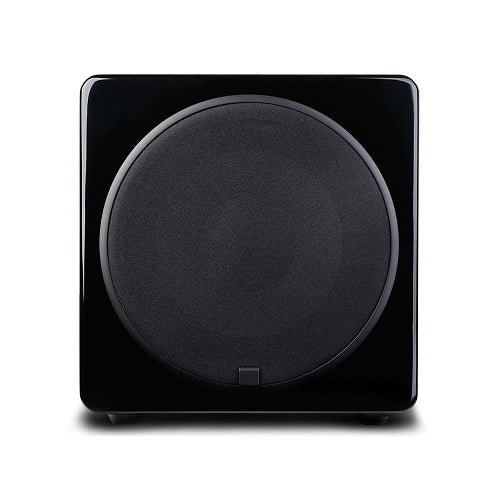
ES-SUB-EVO10-450-BLK has a piano-gloss black finish and flush-mounted grille.
Is a white model available?
Episode also offers the separate ES-SUB-EVO10-450-WHT in gloss white.
What are the dimensions?
It measures approximately 12.5 inches wide, 13.1 inches high, and 13.7 inches deep.
How much does it weigh?
It weighs approximately 25.4 lb.
What is the warranty?
The installation manual documents two years on the amplifier and ten years on the woofer and cabinet, subject to Episode’s warranty terms. The current online specification table shows a simplified two-year entry.
What should I check before ordering?
Check room size, available floor space, receiver or soundbar outputs, preferred connection method, nearby AC power, main-speaker capability, listening level, and whether the EVO10 provides enough output for the room.
Controlled Bass for Movies, Music, and Gaming
The Episode ES-SUB-EVO10-450-BLK is a 10-inch powered subwoofer designed for living rooms, media rooms, gaming systems, music setups, and home theaters that need stronger output than a compact 8-inch model without moving to a much larger cabinet.
Its sealed enclosure contains a woven-fiberglass woofer powered by Episode’s efficient DRiVE Class-D amplifier. LFE, stereo RCA, and speaker-level connections provide compatibility with AV receivers, processors, stereo amplifiers, and other audio systems.
The built-in amplifier delivers 200W RMS and 480W peak. The 480W figure is a peak rating, not continuous amplifier output.
Best Use Cases
- Living rooms: Add movie and music bass without using an oversized cabinet.
- Media rooms: Provide more impact and headroom than the smaller EVO8.
- Home theaters: Reproduce the dedicated LFE channel from a compatible AV receiver or processor.
- Music systems: Extend bookshelf, in-wall, in-ceiling, and floorstanding speakers into lower frequencies.
- Gaming setups: Reinforce effects, soundtracks, vehicles, and environmental audio.
- Systems without a subwoofer pre-out: Connect through the high-level speaker-wire inputs and outputs.
- Wireless retrofit projects: Add the separately sold Episode wireless subwoofer kit when running a long signal cable is impractical.
Who Should Buy This?
This is a strong choice when the EVO8 is too small for the room or preferred listening level, but the size and output of the EVO12 are unnecessary.
It is particularly suitable for buyers who value a sealed enclosure, straightforward rear-panel controls, both line-level and speaker-level connections, and a relatively compact piano-gloss cabinet.
Who Should Not Buy This?
This may not provide enough output for a very large dedicated theater, a large open-concept room, or listeners seeking extremely high playback levels. The larger EVO12 or a higher-output MEGA model may be more appropriate in those situations.
This is not a passive subwoofer. It contains its own amplifier and requires AC power.
It is not wireless out of the box. Wireless audio requires the separately sold Episode wireless subwoofer kit. The rear USB port only supplies power to the optional wireless receiver.
It does not include Bluetooth, Wi-Fi, app control, Ethernet, automatic room correction, or a 12V trigger.
The subwoofer is intended for dry indoor use and should not be exposed to rain, dripping water, outdoor humidity, or blocked ventilation.
Sold Individually
The ES-SUB-EVO10-450-BLK is sold as one complete powered subwoofer.
One subwoofer may provide sufficient bass for many rooms. Two properly positioned subwoofers can improve consistency across multiple listening seats when the receiver or processor supports the required connections and calibration.
10-Inch Woven-Fiberglass Driver
The subwoofer uses one 10-inch woven-fiberglass cone driver with a Nomex spider, ribbed surround, and high-temperature 1.5-inch voice coil.
The rigid, lightweight driver is designed for controlled movement and low-frequency reproduction from the sealed enclosure.
This is a single-driver design. It should not be described as a dual-driver subwoofer or as using a passive radiator.
Sealed Enclosure
The EVO10 uses a sealed cabinet instead of a ported design.
A sealed enclosure supports compact dimensions and controlled transient response, making it a practical choice for music, television, gaming, and home-theater systems.
Actual bass performance still depends on room dimensions, placement, seating location, crossover settings, phase, receiver calibration, and preferred listening level.
200W RMS and 480W Peak Amplification
The built-in DRiVE Class-D amplifier is rated at 200W RMS at 0.2% THD and 480W peak.
The 200W RMS figure is the continuous amplifier rating and should be used as the primary power specification.
The 480W specification represents short-duration peak capability. It should not be described as 480W RMS or continuous output.
No separate subwoofer amplifier is required.
Efficient DRiVE Class-D Technology
Episode’s DRiVE digital amplifier is designed to provide efficient low-frequency power while generating less heat than many conventional analog amplifier designs.
Episode publishes standby power consumption below 0.5W.
The cabinet still requires adequate airflow and access to the rear controls, connections, voltage selector, fuse holder, and power cord.
LFEQ Internal Equalization
Episode’s LFEQ technology uses internal dual equalization to shape the output of the driver and sealed enclosure for extended low-frequency performance.
LFEQ is built-in product tuning. It is not automatic room correction, app-based DSP, or microphone calibration.
Correct placement, crossover, phase, and receiver setup remain necessary.
Published Frequency Performance
Episode’s current online specification table lists a broad published frequency range of 23Hz to 200Hz.
The official installation manual separately identifies approximately 28Hz as the lower -3 dB point.
These values use different reporting conventions. Customer-facing copy should distinguish the broad published range from the documented -3 dB specification instead of treating them as identical measurements.
50Hz–200Hz Adjustable Crossover
The rear crossover control adjusts the highest frequencies reproduced by the subwoofer from approximately 50Hz to 200Hz and includes an LFE position.
The correct setting depends on the low-frequency capability of the main speakers and whether bass management is handled by an AV receiver, processor, or the subwoofer.
When using a receiver’s dedicated Sub Out or LFE output, set the subwoofer control to LFE and manage the crossover through the receiver.
Continuously Adjustable Phase
The rear phase control is continuously variable from 0 to 180 degrees.
Phase adjustment helps align the subwoofer with the main speakers at the listening position.
Begin at 0 degrees and adjust while listening to familiar bass content from the primary seating area. Select the position that produces the strongest and most even integration with the main speakers.
Rear Volume Control
The volume control adjusts subwoofer output relative to the main speakers.
Episode recommends starting near the 12 o’clock or 50% position during setup.
After receiver calibration or manual adjustment, set the level so bass supports movies and music without overpowering dialogue, vocals, or instruments.
RCA and LFE Connections
The rear panel provides left and right low-level RCA inputs and outputs.
For a receiver or processor’s dedicated Sub Out or LFE connection, use the left RCA input, which Episode designates for LFE operation.
The RCA outputs can pass the corresponding low-level signal to another compatible component or subwoofer.
Use a shielded subwoofer or RCA cable with secure connectors.
Speaker-Level Inputs and Outputs
Gold-plated five-way binding posts provide left and right high-level inputs and outputs.
This allows the EVO10 to receive signal from an amplifier or receiver that provides speaker outputs but no dedicated subwoofer preamp output.
The high-level outputs pass the main speaker signal onward. They are not extra speaker channels powered by the EVO10’s internal amplifier.
Use One Input Method
Do not connect the RCA inputs and speaker-level inputs at the same time.
Use either the low-level RCA/LFE connection or the high-level speaker-wire connection.
Connecting both methods simultaneously may cause noise or improper operation.
Automatic Signal Sensing
The rear power-mode control provides Auto, Off, and On settings.
- Auto: Turns on when an audio signal is detected and enters standby after approximately 15 minutes without a signal.
- On: Keeps the subwoofer ready for operation.
- Off: Disables normal operation while AC remains connected.
The status LED is blue during operation and red in standby or when the mode control is set to Off while AC power remains available.
Optional Wireless Subwoofer Kit
The EVO10 is compatible with the separately sold Episode wireless subwoofer kit.
A rear 5V USB port provides up to 500mA to power the optional wireless receiver, and built-in holding bolts allow the receiver to be secured to the rear panel.
The subwoofer itself does not contain a wireless transmitter or receiver.
Wireless operation replaces the long source-signal cable. The powered subwoofer still requires an AC outlet.
AV Receiver Compatibility
Most AV receivers connect through the receiver’s Sub Out or LFE output and the EVO10’s left RCA/LFE input.
Set the crossover control to LFE and run the receiver’s speaker-calibration system when available.
The calculated subwoofer distance shown by the receiver may differ from the physical distance because filtering and phase behavior affect acoustic timing.
Stereo Amplifier Compatibility
A stereo amplifier with variable preamp outputs can connect through the RCA inputs.
An amplifier without a preamp or subwoofer output may connect through the high-level speaker inputs and outputs.
Do not connect the high-level terminals to a 70V or 100V constant-voltage speaker output.
Soundbar Compatibility
The EVO10 can work with a soundbar only when the soundbar or its control unit provides a compatible wired subwoofer, RCA, LFE, or speaker-level output.
It cannot pair directly with soundbars designed only for a proprietary wireless subwoofer.
Confirm the exact soundbar model and available outputs before ordering.
Placement Guidance
Subwoofer placement can significantly change output and bass consistency.
Placement near a wall or corner can increase perceived output, but it may also make certain frequencies excessive while weakening others.
Test several suitable floor positions and evaluate the result from the important listening seats before finalizing cable routing or furniture placement.
Switchable AC Voltage
The ES-SUB-EVO10-450 supports switchable 100–120V or 220–240V AC operation.
Confirm that the rear voltage selector matches the local electrical supply before connecting the power cord.
- 100–120V AC, 60Hz: Approximately 2.5A.
- 220–240V AC, 50Hz: Approximately 1.25A.
- Replaceable fuse: T4AL/250V.
Using the wrong voltage setting or fuse type may damage the subwoofer and create a safety hazard.
Technical Specifications
- Product type: Powered sealed subwoofer.
- Series: Episode Evolution.
- Model: ES-SUB-EVO10-450-BLK.
- Sold as: One powered subwoofer.
- Finish: Piano-gloss black.
- Driver: One 10-inch woven-fiberglass cone.
- Voice coil: High-temperature 1.5-inch voice coil.
- Suspension: Nomex spider and ribbed surround.
- Enclosure: Sealed.
- Amplifier: DRiVE Class-D.
- Continuous output: 200W RMS at 0.2% THD.
- Peak output: 480W.
- Published overall frequency range: 23Hz to 200Hz.
- Manual-specified lower point: Approximately 28Hz at -3 dB.
- Adjustable crossover: 50Hz to 200Hz, plus LFE position.
- Phase adjustment: Continuously variable from 0 to 180 degrees.
- Signal-to-noise ratio: 90 dB A-weighted.
- Low-level connections: Stereo RCA inputs and outputs; left RCA supports LFE.
- High-level connections: Gold-plated five-way binding-post inputs and outputs.
- Wireless support: Compatible with optional Episode wireless kit.
- Wireless-receiver power: 5V USB, up to 500mA.
- Power modes: Auto, Off, and On.
- Automatic standby: Approximately 15 minutes without signal.
- AC input: Switchable 100–120V or 220–240V.
- Replaceable fuse: T4AL/250V.
- Use location: Dry indoor environments.
Dimensions and Weight
- Width: Approximately 12.5 inches.
- Height: Approximately 13.1 inches.
- Depth: Approximately 13.7 inches.
- Weight: Approximately 25.4 lb.
Warranty
The official installation manual documents a two-year limited warranty on the amplifier and a ten-year limited warranty on the woofer and cabinet, subject to Episode’s warranty conditions.
Episode’s current online specification table displays a simplified two-year entry. Confirm the currently applicable component coverage before publishing the longer period as unconditional.
When to Choose Another Evolution Subwoofer
Choose the EVO8 when cabinet size and floor-space savings are more important than additional output.
Choose the EVO12 when the room is larger, listening levels are higher, or deeper extension and stronger output are required.
Choose a MEGA subwoofer when app-based room EQ, parametric DSP, balanced XLR inputs, Ethernet control, a 12V trigger, or substantially higher amplifier power is needed.
Choose the EVO10 when you need a practical balance of cabinet size, output, sealed performance, and connection flexibility.
Good Products to Pair With This Subwoofer
- Subwoofers to compare compact, powered, architectural, and high-output models.
- Episode Products for matching speakers, amplifiers, soundbars, and audio components.
- In-Wall & In-Ceiling Speakers for a discreet home-theater or music system.
- AV Receivers & Surround Sound for LFE output, bass management, and speaker calibration.
- Soundbars with compatible wired subwoofer outputs.
- Power Management Solutions to protect the subwoofer, receiver, television, and source equipment.
Need Help Choosing Between the EVO8, EVO10, and EVO12?
Send us the room dimensions, listening distance, main speaker models, receiver or amplifier model, preferred volume, and available subwoofer locations. We can help determine which Evolution model and connection method best fit the system.
10" Sealed Subwoofer with 480W DRiVE™ Digital Amplifier
Gloss Black Finish with Flush Grill for Sleek Aesthetics
LFEQ™ Dual EQ Tech Delivers Deep, Extended Bass
Woven Fiberglass Driver for Tight, Accurate Low-End
High and Low-Level Input & Output Options
Adjustable Crossover & Phase Control
Signal Sensing Auto Power-On
Perfect Companion to Episode Soundbars and Speakers
Premium Design for Living Rooms and Home Theaters
Is the Episode ES-SUB-EVO10-450-BLK sold individually?
Yes. It is sold as one complete powered subwoofer.
Is this a powered or passive subwoofer?
It is powered and contains its own DRiVE Class-D amplifier.
How much continuous power does it deliver?
The amplifier is rated at 200W RMS at 0.2% THD.
What does the 480W rating mean?
The 480W specification is the peak rating. It is not 480W RMS or continuous output.
Does it require a separate amplifier?
No. The subwoofer amplifier is built into the cabinet.
What size driver does it use?
It uses one 10-inch woven-fiberglass cone driver.
What size is the voice coil?
The installation manual lists a high-temperature 1.5-inch voice coil.
Is the cabinet sealed or ported?
It uses a sealed cabinet.
What is LFEQ?
LFEQ is Episode’s internal equalization technology for shaping the driver and sealed enclosure response. It is not automatic room correction.
What is the frequency response?
Episode’s current online specifications list 23Hz to 200Hz. The installation manual separately identifies approximately 28Hz at -3 dB.
Why are both 23Hz and 28Hz published?
They use different reporting conventions. The 28Hz figure is explicitly identified as the -3 dB point, while 23Hz–200Hz is the broader published range.
What is the adjustable crossover range?
The crossover adjusts from approximately 50Hz to 200Hz and includes an LFE position.
What should the crossover be set to with an AV receiver?
When using the receiver’s Sub Out or LFE connection, set the subwoofer crossover to LFE and manage the crossover through the receiver.
Does it have phase control?
Yes. Phase is continuously adjustable from 0 to 180 degrees.
What is a good initial phase setting?
Begin at 0 degrees and adjust from the main listening position.
What is a good initial volume setting?
Episode recommends starting near 50%, or the 12 o’clock position.
Which RCA input is used for LFE?
Use the left RCA input for a receiver or processor’s dedicated LFE or subwoofer output.
Does it have stereo RCA inputs and outputs?
Yes. It provides left and right low-level RCA inputs and outputs.
Does it have speaker-level inputs?
Yes. Gold-plated five-way binding posts accept left and right speaker-level signals.
Does it have speaker-level outputs?
Yes. The outputs pass the speaker-level signal onward to the main speakers.
Does the internal amplifier power the main speakers?
No. The speaker-level outputs are passthrough connections. The internal amplifier powers only the subwoofer driver.
Can the RCA and speaker-level inputs be connected simultaneously?
No. Use one connection method only.
Can it connect to a soundbar?
Only when the soundbar or its control unit provides a compatible wired subwoofer, RCA, LFE, or speaker-level output.
Does it include Bluetooth or Wi-Fi?
No. It does not include Bluetooth, Wi-Fi, app control, or network streaming.
Is it wireless?
Not by itself. It supports the separately sold Episode wireless subwoofer kit.
What is the USB port used for?
The rear 5V USB port powers the optional Episode wireless receiver.
Can the USB port play music?
No. It is not an audio or music-playback input.
Does wireless operation eliminate the power cord?
No. Wireless replaces the long audio-signal cable. AC power is still required.
Does it turn on automatically?
Yes. In Auto mode, it turns on when an audio signal is detected.
How long before it enters standby?
It enters standby after approximately 15 minutes without a detected signal.
What do the status-light colors mean?
Blue indicates operation. Red indicates standby or that the mode control is set to Off while AC power remains available.
Does it support 120V and 230V power?
Yes. It supports switchable 100–120V or 220–240V operation.
Which fuse does it use?
The installation manual specifies a T4AL/250V replaceable fuse.
What is the power consumption?
The published figures are approximately 2.5A at 100–120V/60Hz and 1.25A at 220–240V/50Hz.
Can it be installed outdoors?
No. It is intended for dry indoor use.
Can it be placed inside a cabinet?
Only when the cabinet provides adequate ventilation, structural support, cable access, and acoustic clearance.
Where should it be placed?
Test several floor positions near the front of the room. A corner may increase output but can also make bass uneven or boomy.
What finish is this model?
ES-SUB-EVO10-450-BLK has a piano-gloss black finish and flush-mounted grille.
Is a white model available?
Episode also offers the separate ES-SUB-EVO10-450-WHT in gloss white.
What are the dimensions?
It measures approximately 12.5 inches wide, 13.1 inches high, and 13.7 inches deep.
How much does it weigh?
It weighs approximately 25.4 lb.
What is the warranty?
The installation manual documents two years on the amplifier and ten years on the woofer and cabinet, subject to Episode’s warranty terms. The current online specification table shows a simplified two-year entry.
What should I check before ordering?
Check room size, available floor space, receiver or soundbar outputs, preferred connection method, nearby AC power, main-speaker capability, listening level, and whether the EVO10 provides enough output for the room.
RELATED PRODUCTS
Discover Other Products You Might Like and Simplify Your Search
Why Customers Keep Coming Back
Real feedback from customers nationwide on our service, shipping, and support.

M. from New Jersey
Outstanding customer service speakers arrived cross country Cali to New Jersey in spectacular condition.
Great communication great packaging would buy again.
R. from California
Easy ordering and super fast standard shipping. Great experience and highly recommended.
G. from Texas
Place a large order and was able to accommodate me quickly and parts were delivered as promised

M. from Louisiana
Product arrived quickly and in good condition. The price was very competitive. I’m very satisfied. I highly recommend the seller.
B. from Texas
Arrived promptly & in excellent condition with all required parts. Sounds great and impedance matches other speakers.
S. from Florida
Excellent customer service! Picks up the phone. Fast delivery across the country. Worthy online retailer!
G. from Texas
Bear Security Shop has a great customer service, and is fast and easy to do business with. I've ordered product from them twice with great service both times. Would definitely recommend them.
J. from Los Angeles
Excellent customer service. Lightning fast shipping. Very grateful for the team at Bear Security. Thank you!
T. from Oklahoma
Trustworthy, honest, and plus integrity, with outstanding professionalism! I highly recommend them buy with confidence!

C. from Colorado
Experience with Bear Security Shop was fast and easy and the speakers arrived less than we week after ordering. And the price was half what my installer wanted to charge me for these speakers. Highly recommended.
V. from California
Excellent communication. Prompt responses and very knowledgeable and helpful. Items arrived faster than expected and in brand new condition as described. Will continue to do business with them.
C. from South Dakota
Awesome camras well worth the money good seller would buy again 👍
Get Expert Picks and Real Setup Advice
Subscribe for practical tips, product recommendations, and occasional subscriber only deals. No spam.