



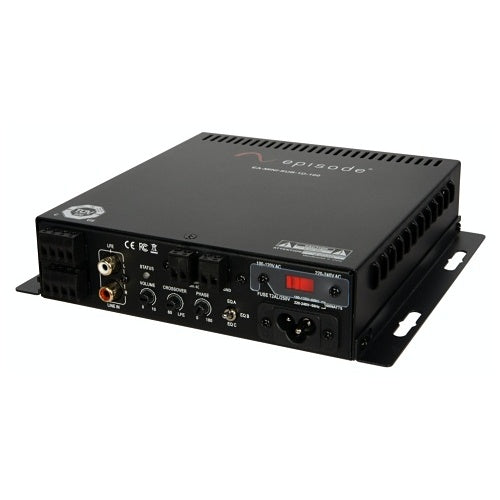

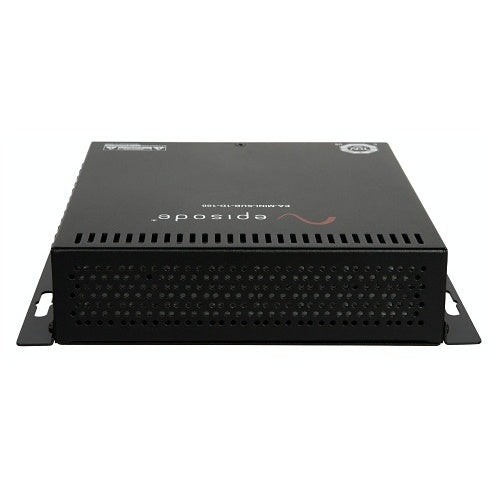
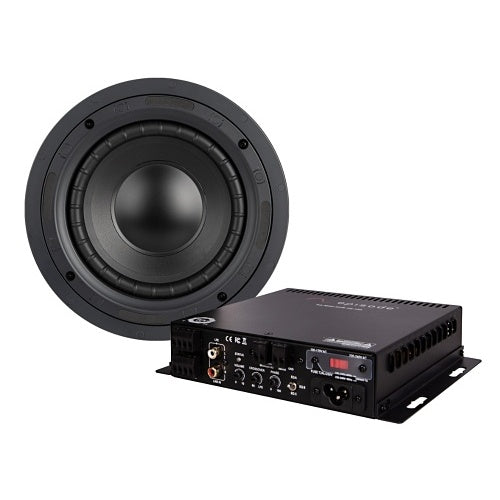
Episode EA-MINI-SUB-1D-100 Digital Subwoofer Mini Amplifier 100W
Compact mono amplifier for powering a passive architectural or small-format subwoofer in bedrooms, living rooms, offices, TV rooms, and whole-home audio zones. Delivers 100W RMS at 4 ohms or 50W RMS at 8 ohms, with RCA/LFE and speaker-level inputs, three enclosure-specific EQ presets, adjustable crossover and phase, and flexible mounting options.
Tax excluded. Shipping calculated at checkout
Free U.S. shipping is available on orders over $499.99.
Personalized pricing may be available for a single item, multiple products, larger quantities, or competitive quotes.
Before You Buy
Check compatibility, what’s included, key specifications, and installation requirements in the Product Details below. Need help confirming compatibility? Contact us before ordering.
Shipping Information
A tracking number is provided by email after the order has shipped. U.S. only: Orders usually process in 1 to 2 business days, with delivery typically taking 3 to 6 business days after shipment. Free shipping on orders over $499.99 For more information, please see our Shipping Policy here.
30 Day Returns & Warranty
We accept returns within 30 days of delivery for unused, uninstalled items in original packaging. Many products also include a manufacturer warranty. For more information, please see our Refund Policy here.
Official Product Resources
EA-MINI-SUB-1D-100 Product Manual & Specs
View the official EA-MINI-SUB-1D-100 manual for product specifications, setup details, wiring guidance, and installation reference before ordering.
Open EA-MINI-SUB-1D-100 Manual PDFOpens the official PDF manual in a new tab, where you can view, save, or print the file from your browser.
Episode EA-MINI-SUB-1D-100 Digital Subwoofer Mini Amplifier 100W
Product Details
Compact Power for a Passive Architectural Subwoofer
The Episode EA-MINI-SUB-1D-100 is a compact digital mono amplifier designed to power a passive subwoofer in small and medium-size rooms, whole-home audio zones, television rooms, offices, bedrooms, and architectural audio systems.
It delivers 100W RMS into a 4-ohm load or 50W RMS into an 8-ohm load. Stereo RCA, LFE, and speaker-level inputs allow it to connect with a wide range of AV receivers, preamplifiers, streaming amplifiers, and multi-room audio systems.
This amplifier is designed for passive subwoofers. It is not required for a powered subwoofer that already contains its own amplifier.
Best Use Cases
- Architectural subwoofers: Power a compatible passive in-wall or in-ceiling subwoofer without adding a large amplifier to the room.
- Bedrooms and offices: Add low-frequency support to a compact music system without using a large floorstanding powered subwoofer.
- TV and media rooms: Improve movie, television, gaming, and music bass in a smaller listening area.
- Whole-home audio zones: Add a dedicated passive subwoofer to a kitchen, living room, bedroom, or other distributed-audio zone.
- Hidden audio systems: Place the compact amplifier on a shelf, inside a properly ventilated cabinet or structured-wiring enclosure, or mount it to a suitable surface.
- Systems without an RCA subwoofer output: Use the speaker-level input and passthrough connections with a compatible amplified speaker-wire signal.
- Wireless retrofit situations: Use the rear 5V connection to power a compatible Episode Wireless Sub Kit receiver, sold separately.
Who Should Buy This?
This is a strong choice when you already have—or plan to install—a passive subwoofer and need a small dedicated amplifier that can be hidden away without occupying the space required by a full-width rack amplifier.
It is especially useful with compatible 4-ohm or 8-ohm architectural subwoofers in small or medium-size rooms where 100W at 4 ohms provides sufficient output.
Who Should Not Buy This?
This amplifier is not needed for a powered subwoofer. Powered subwoofers contain their own amplifier and normally connect directly to a receiver or preamplifier through an RCA or LFE cable.
It is not designed to power full-range left, center, right, surround, or ceiling speakers. Its mono output and bass-frequency controls are intended specifically for passive subwoofer operation.
It is also not the right choice for a large, high-output passive subwoofer that requires substantially more than 100W RMS, or for a large room expected to reach high home-theater listening levels.
The amplifier has no Bluetooth, Wi-Fi, streaming platform, app control, network connection, or built-in wireless audio receiver.
This is indoor equipment. Do not install it outdoors, near water, or in an excessively humid location.
100W RMS at 4 Ohms
The EA-MINI-SUB-1D-100 delivers 100W RMS when connected to a compatible 4-ohm passive subwoofer load.
The 100W figure should not be presented as the output at every impedance. Amplifier output changes according to the connected load:
- 4-ohm load: 100W RMS.
- 8-ohm load: 50W RMS.
- Minimum supported load: 4 ohms.
Confirm the subwoofer’s nominal impedance before connecting it. Do not connect a load below 4 ohms.
Using One Passive Subwoofer
One compatible 4-ohm passive subwoofer allows the amplifier to deliver its full published 100W RMS output.
One 8-ohm passive subwoofer receives up to 50W RMS. This may be appropriate for a smaller room, moderate listening level, or efficient architectural subwoofer.
Power compatibility should be based on the subwoofer’s impedance, recommended amplifier range, enclosure, room size, and intended listening level—not only on the driver diameter.
Using Two Passive Subwoofers
The amplifier can power two compatible passive subwoofers when the complete wiring load remains at or above 4 ohms.
Two 8-ohm subwoofers connected in parallel create a 4-ohm load. The amplifier then supplies up to 100W RMS across the combined load.
This does not provide 100W independently to each subwoofer. The available amplifier power is shared between the connected drivers.
Do not connect two 4-ohm subwoofers in parallel. That would create a 2-ohm load, which is below the amplifier’s published minimum impedance.
RCA Stereo and LFE Inputs
The rear low-level RCA inputs accept left and right line-level signals from a compatible audio source, preamplifier, receiver, or zone amplifier.
For a dedicated AV-receiver subwoofer or LFE output, connect the cable to the amplifier’s left RCA input, which is also identified for LFE use.
When using the LFE input, set the amplifier’s crossover control to its LFE position and make the crossover adjustment through the receiver or preamplifier.
Speaker-Level Input and Passthrough
The high-level input allows the amplifier to receive signal from an existing amplified speaker-wire run when a separate RCA preamp or subwoofer output is unavailable.
A corresponding high-level output provides speaker-wire passthrough for the existing left and right speaker connection.
The published maximum speaker-input passthrough rating is 200W at 4 ohms. The high-level passthrough does not mean that the EA-MINI-SUB-1D-100 powers the main left and right speakers.
Adjustable Volume
The volume control adjusts the output level of the connected passive subwoofer.
A practical initial setting is approximately the 12 o’clock position. Final level should be adjusted from the normal listening position after the main speakers and subwoofer are operating together.
Avoid increasing the level until the subwoofer sounds strained, distorted, or mechanically stressed.
Adjustable Crossover
The crossover control limits the highest frequencies sent to the passive subwoofer.
The correct setting depends on the low-frequency capability of the main speakers, the room, the subwoofer enclosure, and whether bass management is being performed by an AV receiver or external processor.
When using an LFE connection, set the amplifier to LFE and control the crossover through the connected receiver or processor to avoid applying two competing crossover settings.
Phase Adjustment
The phase control helps align the subwoofer’s output with the main speakers at the listening position.
After setting the volume and crossover, adjust phase while playing familiar bass-heavy music or movie content. Select the position that provides the strongest and most even bass from the primary seating area.
The preferred setting depends on subwoofer placement, listening distance, room boundaries, and the phase behavior of the main speakers.
Three Architectural-Subwoofer EQ Presets
The EA-MINI-SUB-1D-100 includes three rear EQ presets optimized around the Episode ES-SUB-SNGL-8 architectural subwoofer and different enclosure volumes.
- Preset A, +4 dB: Optimized for enclosure volumes greater than 4 cubic feet, including appropriate free-air installations without a backbox.
- Preset B, +7 dB: Optimized for enclosure volumes from 1 to 4 cubic feet.
- Preset C, +10 dB: Optimized for enclosure volumes below 1 cubic foot, including compatible compact retrofit or pre-construction enclosures.
These presets are based on enclosure volume, not simply whether the room is small, medium, or large.
When using a different passive subwoofer, confirm that the selected EQ boost is appropriate for that driver and enclosure. Excessive low-frequency boost can increase amplifier demand and driver excursion.
5V Output for an Optional Wireless Receiver
The rear 5V and ground connection can supply power to a compatible Episode Wireless Sub Kit receiver.
The wireless kit is sold separately. The 5V connection does not add Bluetooth, Wi-Fi, or wireless audio capability by itself.
The wireless receiver carries the source signal to the amplifier; speaker wire is still required between the amplifier and the passive subwoofer.
Signal-Sensing and Trigger Control
The amplifier supports signal-sensing activation with a published auto-on sensitivity of 4mV.
It also supports an external trigger voltage from 2V to 20V for integration with compatible source or control equipment.
The front status LED is red when AC power is available and the amplifier is in standby. It changes to blue when the amplifier is on and receiving signal.
120V or 230V Input Selection
A rear voltage selector allows the amplifier to be configured for 120V or 230V electrical service.
Verify that the selector matches the local supply voltage before connecting the power cord. Using the wrong voltage setting can damage the amplifier and create a safety hazard.
Compact Placement Options
The compact chassis can be used in several configurations:
- Shelf or tabletop: Use the included rubber feet on a solid, level surface.
- Wall mounting: Use the included mounting ears with fasteners appropriate for the mounting surface.
- Structured-wiring enclosure: Use the compatible mounting provisions while maintaining adequate ventilation.
- Rack or cabinet: Place it on an appropriate shelf or mounting system with sufficient space for cooling and cable connections.
The amplifier is approximately 1U high but is not a conventional full-width 19-inch component. Verify the mounting method before ordering rack accessories.
Ventilation Requirements
Do not block the cooling vents or place the amplifier on carpeting or another soft surface.
For shelf placement, Episode specifies approximately 5 inches of free air above the amplifier, 3 inches on each side, and at least 2 inches behind it for cables and connectors.
Do not stack other equipment directly on top of the amplifier. Enclosed cabinets and structured-wiring boxes may require additional ventilation.
The published maximum operating ambient temperature is 35°C, or 95°F.
Connections and Controls
- Amplifier channels: One mono subwoofer channel.
- Low-level inputs: Left and right RCA; left input also supports LFE.
- High-level input: Left and right speaker-wire input.
- High-level output: Left and right speaker-wire passthrough.
- Subwoofer output: Screw-down speaker terminals.
- Wireless-accessory power: 5V and ground connection.
- Controls: Volume, crossover/LFE, phase, and three EQ presets.
- Power integration: Signal sensing and external trigger support.
- Input-voltage selector: 120V or 230V.
Technical Specifications
- Product type: Digital mono passive-subwoofer amplifier.
- Model: EA-MINI-SUB-1D-100.
- Channels: One.
- Output at 4 ohms: 100W RMS.
- Output at 8 ohms: 50W RMS.
- Minimum speaker load: 4 ohms.
- Frequency response: 30Hz to 200Hz.
- Input sensitivity: 140mV for full output with the left/LFE input driven and level set to maximum.
- Published distortion: 0.10% THD+N at 1W/2W and 100Hz.
- High-level passthrough: Up to 200W at 4 ohms.
- Auto-on sensitivity: 4mV.
- External trigger range: 2V to 20V.
- Certification: TUV listed and tested for the United States and Canada.
- Warranty: Two-year manufacturer warranty, subject to current warranty terms.
Dimensions and Weight
- Width: Approximately 6.68 inches.
- Height: Approximately 1.75 inches.
- Depth: Approximately 7.11 inches from the front switch to the rear chassis.
- Weight: Approximately 5.1 lb.
- Height classification: 1U.
Choosing a Compatible Passive Subwoofer
Confirm all of the following before connecting a subwoofer:
- The subwoofer is passive and does not contain its own amplifier.
- The complete connected load is 4 ohms or higher.
- The subwoofer’s recommended amplification range is appropriate for 50W or 100W RMS.
- The selected EQ preset is suitable for the driver and enclosure volume.
- The room size and expected listening level are realistic for the amplifier’s available power.
Do not assume that every 8-inch or architectural subwoofer is automatically compatible. Driver impedance, enclosure design, wiring configuration, and recommended amplifier power must all be considered.
When to Choose a Larger Subwoofer Amplifier
Choose a higher-powered subwoofer amplifier when the passive subwoofer requires more than 100W RMS, the room is large, the listening level is demanding, or the system uses a larger high-excursion subwoofer.
A larger amplifier may also be more appropriate when several subwoofers must operate at higher output or when advanced DSP, front-panel control, or broader system-integration features are required.
Good Products to Pair With This Amplifier
- Subwoofers to compare compatible passive and powered subwoofer options.
- Episode Products for matching architectural speakers, subwoofers, and audio components.
- Amplifiers to compare stereo, multi-zone, home-theater, and higher-powered subwoofer amplification.
- AV Receivers & Surround Sound for compatible source and home-theater equipment.
- Speaker Wires for correctly sized passive-subwoofer and high-level connections.
- Power Management Solutions to protect the amplifier, receiver, source equipment, and networking components.
Need Help Confirming Compatibility?
Send us the passive subwoofer model, nominal impedance, enclosure type, room dimensions, source or receiver model, and whether you plan to connect one or two subwoofers. We can help confirm the expected amplifier load, input method, EQ preset, and whether this 100W model is the right fit.
Key Features
100W 1-Channel Digital Subwoofer Amplifier – High-performance bass in a compact design
Compact & Versatile Installation – Mount on wall, rack, or tabletop with ease
Pairs with Episode 8" Architectural Sub – Seamless integration for deep, powerful bass
Dedicated Subwoofer Output per Zone – Perfect for multi-zone audio systems
Supports Stereo, LFE, & High-Level Inputs – Flexible connectivity options for any setup
5V Output for Wireless Sub Kit – Compatible with wireless subwoofer receivers
Three EQ Presets – Optimize bass performance for small and medium rooms
Powers Two Subs Simultaneously – Add versatility to your home theater or audio setup
Ideal for Small to Medium Rooms – Compact power for bedrooms, living rooms, and offices
Perfect for Home Theaters & Distributed Audio – Expandable for whole-home bass solutions
FAQ
Is the EA-MINI-SUB-1D-100 for a passive or powered subwoofer?
It is designed for a passive subwoofer. A powered subwoofer already includes its own amplifier and does not require this product.
Is this a one-channel or two-channel amplifier?
It is a one-channel mono subwoofer amplifier.
How much power does it deliver?
It delivers 100W RMS into a 4-ohm load or 50W RMS into an 8-ohm load.
Does it always deliver 100W?
No. The published 100W RMS rating applies at 4 ohms. Output is 50W RMS at 8 ohms.
What is the minimum supported impedance?
The minimum published subwoofer load is 4 ohms.
Can it power two passive subwoofers?
Yes, when the complete connected load remains at or above 4 ohms. Two 8-ohm subwoofers can be connected in parallel to create a 4-ohm load.
Does each of two connected subwoofers receive 100W?
No. The two subwoofers share the amplifier’s available 100W RMS output.
Can I connect two 4-ohm subwoofers in parallel?
No. Two 4-ohm subwoofers in parallel create a 2-ohm load, which is below the amplifier’s published 4-ohm minimum.
Can I connect a single 4-ohm subwoofer?
Yes. A compatible single 4-ohm passive subwoofer allows the amplifier to deliver its full published 100W RMS output.
Can I connect a single 8-ohm subwoofer?
Yes. The amplifier delivers up to 50W RMS into an 8-ohm load.
Can it power regular ceiling or wall speakers?
No. It is a mono bass amplifier designed for passive subwoofers, not full-range speakers.
How do I connect it to an AV receiver?
Connect the receiver’s subwoofer or LFE output to the amplifier’s left RCA input, which is designated for LFE use.
Which RCA input should I use for LFE?
Use the left RCA input.
Does it support stereo RCA input?
Yes. It provides left and right low-level RCA inputs.
What should I do with the crossover control when using LFE?
Set the amplifier’s crossover control to LFE and make crossover adjustments through the connected receiver or processor.
Can I use it when my amplifier has no subwoofer pre-out?
Yes. It provides high-level speaker-wire inputs and outputs for integration with a compatible amplified speaker run.
Does the high-level output power the main speakers?
No. It is a passthrough connection for the existing speaker-level signal. The EA-MINI-SUB-1D-100 powers only the connected passive subwoofer.
What is the high-level passthrough rating?
The published maximum speaker-input passthrough rating is 200W at 4 ohms.
What type of speaker output does it use?
The passive subwoofer connects to screw-down speaker terminals.
What speaker wire should I use?
Episode recommends 14- to 18-gauge stranded two-conductor speaker wire, with the final gauge selected according to cable distance and subwoofer load.
What is the amplifier’s frequency response?
The published frequency response is 30Hz to 200Hz.
Does it have an adjustable crossover?
Yes. The crossover limits the highest frequencies reproduced by the subwoofer and includes an LFE position for receiver-controlled bass management.
Does it have phase control?
Yes. The phase control helps align the subwoofer with the main speakers at the listening position.
What do the three EQ presets do?
They apply different bass boosts optimized for the Episode ES-SUB-SNGL-8 architectural subwoofer and different enclosure volumes.
What is EQ Preset A?
Preset A applies a +4 dB setting optimized for enclosure volumes greater than 4 cubic feet, including appropriate free-air installations.
What is EQ Preset B?
Preset B applies a +7 dB setting optimized for enclosure volumes from 1 to 4 cubic feet.
What is EQ Preset C?
Preset C applies a +10 dB setting optimized for enclosure volumes below 1 cubic foot.
Are the EQ presets based on room size?
No. The official guidance bases the presets on the architectural subwoofer’s enclosure or cavity volume.
Can I use the presets with another subwoofer brand?
Possibly, but the official presets are optimized for the Episode ES-SUB-SNGL-8. Confirm that the selected boost is safe and appropriate for the other subwoofer and enclosure.
Does it include wireless audio?
No. It does not include a wireless audio receiver.
What is the 5V output used for?
It can power a compatible Episode Wireless Sub Kit receiver, sold separately.
Does the wireless kit eliminate the speaker wire?
No. It can replace the source-signal cable to the amplifier, but speaker wire is still required from the amplifier to the passive subwoofer.
Does it include Bluetooth or Wi-Fi?
No. It has no Bluetooth, Wi-Fi, network connection, streaming service, or app control.
Does it turn on automatically?
It supports signal-sensing activation with a published auto-on sensitivity of 4mV.
Does it support a trigger connection?
Yes. The published supported external trigger range is 2V to 20V.
What do the status-light colors mean?
Red indicates that AC power is available while the amplifier is in standby. Blue indicates that it is on and receiving signal.
Can it operate on 120V and 230V power?
Yes. It has a rear 120V/230V selector. Confirm the correct setting before connecting power.
Can it be placed behind a television?
Only when there is enough clearance, ventilation, and access for the power and audio connections. Do not block the side vents or enclose the amplifier in a tight unventilated space.
Can it be installed inside a cabinet?
Yes, provided the cabinet has adequate airflow and the required clearance around the amplifier.
Can it be wall-mounted?
Yes. Episode includes mounting ears, but the installer must supply fasteners appropriate for the mounting surface.
Can it be placed in a structured-wiring enclosure?
Yes, when suitable mounting provisions and adequate ventilation are provided.
Can it sit on a shelf?
Yes. Included rubber feet support horizontal shelf or tabletop placement on a solid, level surface.
Can another component be stacked on top?
No. Episode specifically warns against stacking equipment on top of the amplifier.
How much ventilation does it need?
For shelf placement, Episode specifies approximately 5 inches above, 3 inches on each side, and at least 2 inches behind the amplifier for cooling and cable clearance.
Can it be installed outdoors?
No. It is indoor equipment and should not be exposed to rain, moisture, dripping water, or excessively humid conditions.
What is the maximum published ambient temperature?
The official manual specifies a maximum ambient temperature of 35°C, or 95°F.
What are the amplifier dimensions?
It measures approximately 6.68 inches wide, 1.75 inches high, and 7.11 inches deep from the front switch to the rear chassis.
How much does it weigh?
It weighs approximately 5.1 lb.
Is it a full-width rack amplifier?
No. It has a compact 1U-high chassis rather than a conventional full-width 19-inch enclosure. Confirm the intended rack shelf or mounting method.
What is the warranty?
The current official specification lists a two-year manufacturer warranty, subject to the applicable warranty terms.
What should I check before ordering?
Check whether the subwoofer is passive, its nominal impedance, recommended amplifier power, enclosure volume, room size, source connection, available ventilation, supply voltage, and whether one or two subwoofers will be connected.
Compact Power for a Passive Architectural Subwoofer
The Episode EA-MINI-SUB-1D-100 is a compact digital mono amplifier designed to power a passive subwoofer in small and medium-size rooms, whole-home audio zones, television rooms, offices, bedrooms, and architectural audio systems.
It delivers 100W RMS into a 4-ohm load or 50W RMS into an 8-ohm load. Stereo RCA, LFE, and speaker-level inputs allow it to connect with a wide range of AV receivers, preamplifiers, streaming amplifiers, and multi-room audio systems.
This amplifier is designed for passive subwoofers. It is not required for a powered subwoofer that already contains its own amplifier.
Best Use Cases
- Architectural subwoofers: Power a compatible passive in-wall or in-ceiling subwoofer without adding a large amplifier to the room.
- Bedrooms and offices: Add low-frequency support to a compact music system without using a large floorstanding powered subwoofer.
- TV and media rooms: Improve movie, television, gaming, and music bass in a smaller listening area.
- Whole-home audio zones: Add a dedicated passive subwoofer to a kitchen, living room, bedroom, or other distributed-audio zone.
- Hidden audio systems: Place the compact amplifier on a shelf, inside a properly ventilated cabinet or structured-wiring enclosure, or mount it to a suitable surface.
- Systems without an RCA subwoofer output: Use the speaker-level input and passthrough connections with a compatible amplified speaker-wire signal.
- Wireless retrofit situations: Use the rear 5V connection to power a compatible Episode Wireless Sub Kit receiver, sold separately.
Who Should Buy This?
This is a strong choice when you already have—or plan to install—a passive subwoofer and need a small dedicated amplifier that can be hidden away without occupying the space required by a full-width rack amplifier.
It is especially useful with compatible 4-ohm or 8-ohm architectural subwoofers in small or medium-size rooms where 100W at 4 ohms provides sufficient output.
Who Should Not Buy This?
This amplifier is not needed for a powered subwoofer. Powered subwoofers contain their own amplifier and normally connect directly to a receiver or preamplifier through an RCA or LFE cable.
It is not designed to power full-range left, center, right, surround, or ceiling speakers. Its mono output and bass-frequency controls are intended specifically for passive subwoofer operation.
It is also not the right choice for a large, high-output passive subwoofer that requires substantially more than 100W RMS, or for a large room expected to reach high home-theater listening levels.
The amplifier has no Bluetooth, Wi-Fi, streaming platform, app control, network connection, or built-in wireless audio receiver.
This is indoor equipment. Do not install it outdoors, near water, or in an excessively humid location.
100W RMS at 4 Ohms
The EA-MINI-SUB-1D-100 delivers 100W RMS when connected to a compatible 4-ohm passive subwoofer load.
The 100W figure should not be presented as the output at every impedance. Amplifier output changes according to the connected load:
- 4-ohm load: 100W RMS.
- 8-ohm load: 50W RMS.
- Minimum supported load: 4 ohms.
Confirm the subwoofer’s nominal impedance before connecting it. Do not connect a load below 4 ohms.
Using One Passive Subwoofer
One compatible 4-ohm passive subwoofer allows the amplifier to deliver its full published 100W RMS output.
One 8-ohm passive subwoofer receives up to 50W RMS. This may be appropriate for a smaller room, moderate listening level, or efficient architectural subwoofer.
Power compatibility should be based on the subwoofer’s impedance, recommended amplifier range, enclosure, room size, and intended listening level—not only on the driver diameter.
Using Two Passive Subwoofers
The amplifier can power two compatible passive subwoofers when the complete wiring load remains at or above 4 ohms.
Two 8-ohm subwoofers connected in parallel create a 4-ohm load. The amplifier then supplies up to 100W RMS across the combined load.
This does not provide 100W independently to each subwoofer. The available amplifier power is shared between the connected drivers.
Do not connect two 4-ohm subwoofers in parallel. That would create a 2-ohm load, which is below the amplifier’s published minimum impedance.
RCA Stereo and LFE Inputs
The rear low-level RCA inputs accept left and right line-level signals from a compatible audio source, preamplifier, receiver, or zone amplifier.
For a dedicated AV-receiver subwoofer or LFE output, connect the cable to the amplifier’s left RCA input, which is also identified for LFE use.
When using the LFE input, set the amplifier’s crossover control to its LFE position and make the crossover adjustment through the receiver or preamplifier.
Speaker-Level Input and Passthrough
The high-level input allows the amplifier to receive signal from an existing amplified speaker-wire run when a separate RCA preamp or subwoofer output is unavailable.
A corresponding high-level output provides speaker-wire passthrough for the existing left and right speaker connection.
The published maximum speaker-input passthrough rating is 200W at 4 ohms. The high-level passthrough does not mean that the EA-MINI-SUB-1D-100 powers the main left and right speakers.
Adjustable Volume
The volume control adjusts the output level of the connected passive subwoofer.
A practical initial setting is approximately the 12 o’clock position. Final level should be adjusted from the normal listening position after the main speakers and subwoofer are operating together.
Avoid increasing the level until the subwoofer sounds strained, distorted, or mechanically stressed.
Adjustable Crossover
The crossover control limits the highest frequencies sent to the passive subwoofer.
The correct setting depends on the low-frequency capability of the main speakers, the room, the subwoofer enclosure, and whether bass management is being performed by an AV receiver or external processor.
When using an LFE connection, set the amplifier to LFE and control the crossover through the connected receiver or processor to avoid applying two competing crossover settings.
Phase Adjustment
The phase control helps align the subwoofer’s output with the main speakers at the listening position.
After setting the volume and crossover, adjust phase while playing familiar bass-heavy music or movie content. Select the position that provides the strongest and most even bass from the primary seating area.
The preferred setting depends on subwoofer placement, listening distance, room boundaries, and the phase behavior of the main speakers.
Three Architectural-Subwoofer EQ Presets
The EA-MINI-SUB-1D-100 includes three rear EQ presets optimized around the Episode ES-SUB-SNGL-8 architectural subwoofer and different enclosure volumes.
- Preset A, +4 dB: Optimized for enclosure volumes greater than 4 cubic feet, including appropriate free-air installations without a backbox.
- Preset B, +7 dB: Optimized for enclosure volumes from 1 to 4 cubic feet.
- Preset C, +10 dB: Optimized for enclosure volumes below 1 cubic foot, including compatible compact retrofit or pre-construction enclosures.
These presets are based on enclosure volume, not simply whether the room is small, medium, or large.
When using a different passive subwoofer, confirm that the selected EQ boost is appropriate for that driver and enclosure. Excessive low-frequency boost can increase amplifier demand and driver excursion.
5V Output for an Optional Wireless Receiver
The rear 5V and ground connection can supply power to a compatible Episode Wireless Sub Kit receiver.
The wireless kit is sold separately. The 5V connection does not add Bluetooth, Wi-Fi, or wireless audio capability by itself.
The wireless receiver carries the source signal to the amplifier; speaker wire is still required between the amplifier and the passive subwoofer.
Signal-Sensing and Trigger Control
The amplifier supports signal-sensing activation with a published auto-on sensitivity of 4mV.
It also supports an external trigger voltage from 2V to 20V for integration with compatible source or control equipment.
The front status LED is red when AC power is available and the amplifier is in standby. It changes to blue when the amplifier is on and receiving signal.
120V or 230V Input Selection
A rear voltage selector allows the amplifier to be configured for 120V or 230V electrical service.
Verify that the selector matches the local supply voltage before connecting the power cord. Using the wrong voltage setting can damage the amplifier and create a safety hazard.
Compact Placement Options
The compact chassis can be used in several configurations:
- Shelf or tabletop: Use the included rubber feet on a solid, level surface.
- Wall mounting: Use the included mounting ears with fasteners appropriate for the mounting surface.
- Structured-wiring enclosure: Use the compatible mounting provisions while maintaining adequate ventilation.
- Rack or cabinet: Place it on an appropriate shelf or mounting system with sufficient space for cooling and cable connections.
The amplifier is approximately 1U high but is not a conventional full-width 19-inch component. Verify the mounting method before ordering rack accessories.
Ventilation Requirements
Do not block the cooling vents or place the amplifier on carpeting or another soft surface.
For shelf placement, Episode specifies approximately 5 inches of free air above the amplifier, 3 inches on each side, and at least 2 inches behind it for cables and connectors.
Do not stack other equipment directly on top of the amplifier. Enclosed cabinets and structured-wiring boxes may require additional ventilation.
The published maximum operating ambient temperature is 35°C, or 95°F.
Connections and Controls
- Amplifier channels: One mono subwoofer channel.
- Low-level inputs: Left and right RCA; left input also supports LFE.
- High-level input: Left and right speaker-wire input.
- High-level output: Left and right speaker-wire passthrough.
- Subwoofer output: Screw-down speaker terminals.
- Wireless-accessory power: 5V and ground connection.
- Controls: Volume, crossover/LFE, phase, and three EQ presets.
- Power integration: Signal sensing and external trigger support.
- Input-voltage selector: 120V or 230V.
Technical Specifications
- Product type: Digital mono passive-subwoofer amplifier.
- Model: EA-MINI-SUB-1D-100.
- Channels: One.
- Output at 4 ohms: 100W RMS.
- Output at 8 ohms: 50W RMS.
- Minimum speaker load: 4 ohms.
- Frequency response: 30Hz to 200Hz.
- Input sensitivity: 140mV for full output with the left/LFE input driven and level set to maximum.
- Published distortion: 0.10% THD+N at 1W/2W and 100Hz.
- High-level passthrough: Up to 200W at 4 ohms.
- Auto-on sensitivity: 4mV.
- External trigger range: 2V to 20V.
- Certification: TUV listed and tested for the United States and Canada.
- Warranty: Two-year manufacturer warranty, subject to current warranty terms.
Dimensions and Weight
- Width: Approximately 6.68 inches.
- Height: Approximately 1.75 inches.
- Depth: Approximately 7.11 inches from the front switch to the rear chassis.
- Weight: Approximately 5.1 lb.
- Height classification: 1U.
Choosing a Compatible Passive Subwoofer
Confirm all of the following before connecting a subwoofer:
- The subwoofer is passive and does not contain its own amplifier.
- The complete connected load is 4 ohms or higher.
- The subwoofer’s recommended amplification range is appropriate for 50W or 100W RMS.
- The selected EQ preset is suitable for the driver and enclosure volume.
- The room size and expected listening level are realistic for the amplifier’s available power.
Do not assume that every 8-inch or architectural subwoofer is automatically compatible. Driver impedance, enclosure design, wiring configuration, and recommended amplifier power must all be considered.
When to Choose a Larger Subwoofer Amplifier
Choose a higher-powered subwoofer amplifier when the passive subwoofer requires more than 100W RMS, the room is large, the listening level is demanding, or the system uses a larger high-excursion subwoofer.
A larger amplifier may also be more appropriate when several subwoofers must operate at higher output or when advanced DSP, front-panel control, or broader system-integration features are required.
Good Products to Pair With This Amplifier
- Subwoofers to compare compatible passive and powered subwoofer options.
- Episode Products for matching architectural speakers, subwoofers, and audio components.
- Amplifiers to compare stereo, multi-zone, home-theater, and higher-powered subwoofer amplification.
- AV Receivers & Surround Sound for compatible source and home-theater equipment.
- Speaker Wires for correctly sized passive-subwoofer and high-level connections.
- Power Management Solutions to protect the amplifier, receiver, source equipment, and networking components.
Need Help Confirming Compatibility?
Send us the passive subwoofer model, nominal impedance, enclosure type, room dimensions, source or receiver model, and whether you plan to connect one or two subwoofers. We can help confirm the expected amplifier load, input method, EQ preset, and whether this 100W model is the right fit.
100W 1-Channel Digital Subwoofer Amplifier – High-performance bass in a compact design
Compact & Versatile Installation – Mount on wall, rack, or tabletop with ease
Pairs with Episode 8" Architectural Sub – Seamless integration for deep, powerful bass
Dedicated Subwoofer Output per Zone – Perfect for multi-zone audio systems
Supports Stereo, LFE, & High-Level Inputs – Flexible connectivity options for any setup
5V Output for Wireless Sub Kit – Compatible with wireless subwoofer receivers
Three EQ Presets – Optimize bass performance for small and medium rooms
Powers Two Subs Simultaneously – Add versatility to your home theater or audio setup
Ideal for Small to Medium Rooms – Compact power for bedrooms, living rooms, and offices
Perfect for Home Theaters & Distributed Audio – Expandable for whole-home bass solutions
Is the EA-MINI-SUB-1D-100 for a passive or powered subwoofer?
It is designed for a passive subwoofer. A powered subwoofer already includes its own amplifier and does not require this product.
Is this a one-channel or two-channel amplifier?
It is a one-channel mono subwoofer amplifier.
How much power does it deliver?
It delivers 100W RMS into a 4-ohm load or 50W RMS into an 8-ohm load.
Does it always deliver 100W?
No. The published 100W RMS rating applies at 4 ohms. Output is 50W RMS at 8 ohms.
What is the minimum supported impedance?
The minimum published subwoofer load is 4 ohms.
Can it power two passive subwoofers?
Yes, when the complete connected load remains at or above 4 ohms. Two 8-ohm subwoofers can be connected in parallel to create a 4-ohm load.
Does each of two connected subwoofers receive 100W?
No. The two subwoofers share the amplifier’s available 100W RMS output.
Can I connect two 4-ohm subwoofers in parallel?
No. Two 4-ohm subwoofers in parallel create a 2-ohm load, which is below the amplifier’s published 4-ohm minimum.
Can I connect a single 4-ohm subwoofer?
Yes. A compatible single 4-ohm passive subwoofer allows the amplifier to deliver its full published 100W RMS output.
Can I connect a single 8-ohm subwoofer?
Yes. The amplifier delivers up to 50W RMS into an 8-ohm load.
Can it power regular ceiling or wall speakers?
No. It is a mono bass amplifier designed for passive subwoofers, not full-range speakers.
How do I connect it to an AV receiver?
Connect the receiver’s subwoofer or LFE output to the amplifier’s left RCA input, which is designated for LFE use.
Which RCA input should I use for LFE?
Use the left RCA input.
Does it support stereo RCA input?
Yes. It provides left and right low-level RCA inputs.
What should I do with the crossover control when using LFE?
Set the amplifier’s crossover control to LFE and make crossover adjustments through the connected receiver or processor.
Can I use it when my amplifier has no subwoofer pre-out?
Yes. It provides high-level speaker-wire inputs and outputs for integration with a compatible amplified speaker run.
Does the high-level output power the main speakers?
No. It is a passthrough connection for the existing speaker-level signal. The EA-MINI-SUB-1D-100 powers only the connected passive subwoofer.
What is the high-level passthrough rating?
The published maximum speaker-input passthrough rating is 200W at 4 ohms.
What type of speaker output does it use?
The passive subwoofer connects to screw-down speaker terminals.
What speaker wire should I use?
Episode recommends 14- to 18-gauge stranded two-conductor speaker wire, with the final gauge selected according to cable distance and subwoofer load.
What is the amplifier’s frequency response?
The published frequency response is 30Hz to 200Hz.
Does it have an adjustable crossover?
Yes. The crossover limits the highest frequencies reproduced by the subwoofer and includes an LFE position for receiver-controlled bass management.
Does it have phase control?
Yes. The phase control helps align the subwoofer with the main speakers at the listening position.
What do the three EQ presets do?
They apply different bass boosts optimized for the Episode ES-SUB-SNGL-8 architectural subwoofer and different enclosure volumes.
What is EQ Preset A?
Preset A applies a +4 dB setting optimized for enclosure volumes greater than 4 cubic feet, including appropriate free-air installations.
What is EQ Preset B?
Preset B applies a +7 dB setting optimized for enclosure volumes from 1 to 4 cubic feet.
What is EQ Preset C?
Preset C applies a +10 dB setting optimized for enclosure volumes below 1 cubic foot.
Are the EQ presets based on room size?
No. The official guidance bases the presets on the architectural subwoofer’s enclosure or cavity volume.
Can I use the presets with another subwoofer brand?
Possibly, but the official presets are optimized for the Episode ES-SUB-SNGL-8. Confirm that the selected boost is safe and appropriate for the other subwoofer and enclosure.
Does it include wireless audio?
No. It does not include a wireless audio receiver.
What is the 5V output used for?
It can power a compatible Episode Wireless Sub Kit receiver, sold separately.
Does the wireless kit eliminate the speaker wire?
No. It can replace the source-signal cable to the amplifier, but speaker wire is still required from the amplifier to the passive subwoofer.
Does it include Bluetooth or Wi-Fi?
No. It has no Bluetooth, Wi-Fi, network connection, streaming service, or app control.
Does it turn on automatically?
It supports signal-sensing activation with a published auto-on sensitivity of 4mV.
Does it support a trigger connection?
Yes. The published supported external trigger range is 2V to 20V.
What do the status-light colors mean?
Red indicates that AC power is available while the amplifier is in standby. Blue indicates that it is on and receiving signal.
Can it operate on 120V and 230V power?
Yes. It has a rear 120V/230V selector. Confirm the correct setting before connecting power.
Can it be placed behind a television?
Only when there is enough clearance, ventilation, and access for the power and audio connections. Do not block the side vents or enclose the amplifier in a tight unventilated space.
Can it be installed inside a cabinet?
Yes, provided the cabinet has adequate airflow and the required clearance around the amplifier.
Can it be wall-mounted?
Yes. Episode includes mounting ears, but the installer must supply fasteners appropriate for the mounting surface.
Can it be placed in a structured-wiring enclosure?
Yes, when suitable mounting provisions and adequate ventilation are provided.
Can it sit on a shelf?
Yes. Included rubber feet support horizontal shelf or tabletop placement on a solid, level surface.
Can another component be stacked on top?
No. Episode specifically warns against stacking equipment on top of the amplifier.
How much ventilation does it need?
For shelf placement, Episode specifies approximately 5 inches above, 3 inches on each side, and at least 2 inches behind the amplifier for cooling and cable clearance.
Can it be installed outdoors?
No. It is indoor equipment and should not be exposed to rain, moisture, dripping water, or excessively humid conditions.
What is the maximum published ambient temperature?
The official manual specifies a maximum ambient temperature of 35°C, or 95°F.
What are the amplifier dimensions?
It measures approximately 6.68 inches wide, 1.75 inches high, and 7.11 inches deep from the front switch to the rear chassis.
How much does it weigh?
It weighs approximately 5.1 lb.
Is it a full-width rack amplifier?
No. It has a compact 1U-high chassis rather than a conventional full-width 19-inch enclosure. Confirm the intended rack shelf or mounting method.
What is the warranty?
The current official specification lists a two-year manufacturer warranty, subject to the applicable warranty terms.
What should I check before ordering?
Check whether the subwoofer is passive, its nominal impedance, recommended amplifier power, enclosure volume, room size, source connection, available ventilation, supply voltage, and whether one or two subwoofers will be connected.
RELATED PRODUCTS
Discover Other Products You Might Like and Simplify Your Search
Why Customers Keep Coming Back
Real feedback from customers nationwide on our service, shipping, and support.

M. from New Jersey
Outstanding customer service speakers arrived cross country Cali to New Jersey in spectacular condition.
Great communication great packaging would buy again.

M. from Louisiana
Product arrived quickly and in good condition. The price was very competitive. I’m very satisfied. I highly recommend the seller.
G. from Texas
Place a large order and was able to accommodate me quickly and parts were delivered as promised
R. from California
Easy ordering and super fast standard shipping. Great experience and highly recommended.
B. from Texas
Arrived promptly & in excellent condition with all required parts. Sounds great and impedance matches other speakers.
E. from Arizona
Great products, easy ordering, prompt shipping
S. from Florida
Excellent customer service! Picks up the phone. Fast delivery across the country. Worthy online retailer!
G. from Texas
Bear Security Shop has a great customer service, and is fast and easy to do business with. I've ordered product from them twice with great service both times. Would definitely recommend them.
J. from Los Angeles
Excellent customer service. Lightning fast shipping. Very grateful for the team at Bear Security. Thank you!
T. from Oklahoma
Trustworthy, honest, and plus integrity, with outstanding professionalism! I highly recommend them buy with confidence!

C. from Colorado
Experience with Bear Security Shop was fast and easy and the speakers arrived less than we week after ordering. And the price was half what my installer wanted to charge me for these speakers. Highly recommended.
V. from California
Excellent communication. Prompt responses and very knowledgeable and helpful. Items arrived faster than expected and in brand new condition as described. Will continue to do business with them.
C. from South Dakota
Awesome camras well worth the money good seller would buy again 👍
Get Expert Picks and Real Setup Advice
Subscribe for practical tips, product recommendations, and occasional subscriber only deals. No spam.